there
your number line
8. Draw a number line like the one in
Then plot 0, 0.3, and \frac{1}{3} on your number line in
such a way that each number falls on a tick mark.
Lengthen the tick marks of whole numbers.
9. Draw a number line like the one in Figure 2.49.
Then plot 1, \frac{5}{6}, and \frac{7}{6} on your number line in such
a way that each number falls on a tick mark.
Lengthen the tick marks of whole numbers.
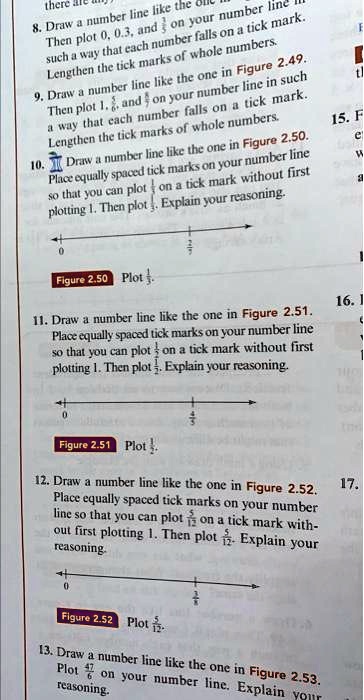
10.
Draw a number line like the one in Figure 2.50.
Place equally spaced tick marks on your number line
so that you can plot \frac{1}{3} on a tick mark without first
plotting 1. Then plot \frac{2}{3}. Explain your reasoning.
0
\frac{1}{3}
Figure 2.50 Plot \frac{1}{3}.
11. Draw a number line like the one in Figure 2.51.
Place equally spaced tick marks on your number line
so that you can plot \frac{1}{4} on a tick mark without first
plotting 1. Then plot \frac{3}{4}. Explain your reasoning.
0
\frac{3}{4}
Figure 2.51 Plot \frac{3}{4}.
12. Draw a number line like the one in Figure 2.52.
Place equally spaced tick marks on your number
line so that you can plot \frac{5}{12} on a tick mark with-
out first plotting 1. Then plot \frac{5}{12}. Explain your
reasoning.
0
\frac{2}{3}
Figure 2.52 Plot \frac{5}{12}.
13. Draw a number line like the one in Figure 2.53.
Plot \frac{47}{6} on your number line. Explain your
reasoning.