Ace - AI Tutor
Ask Our Educators
Textbooks
My Library
Flashcards
Scribe - AI Notes
Notes & Exams
Download App
curtis mar-

curtis m.

Divider

Questions asked

BEST MATCH

Kate Inc. used the acquisition method when it acquired its investment in Meghan Co. Kate Inc. now sells some of its shares of Meghan such that neither control nor significant influence exists. Which of the following statements is true?

View Answer
divider
BEST MATCH

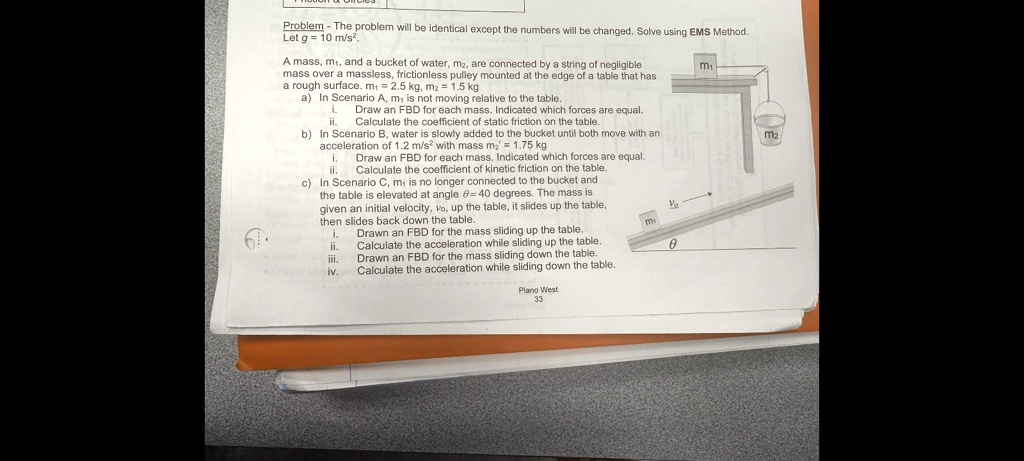
Problem - The problem will be identical except the numbers will be changed. Solve using EMS Method. Let $g = 10 \text{ m/s}^2$. A mass, $m_1$, and a bucket of water, $m_2$, are connected by a string of negligible mass over a massless, frictionless pulley mounted at the edge of a table that has a rough surface. $m_1 = 2.5 \text{ kg}$, $m_2 = 1.5 \text{ kg}$ a) In Scenario A, $m_1$ is not moving relative to the table. i. Draw an FBD for each mass. Indicated which forces are equal. ii. Calculate the coefficient of static friction on the table. b) In Scenario B, water is slowly added to the bucket until both move with an acceleration of $1.2 \text{ m/s}^2$ with mass $m_2' = 1.75 \text{ kg}$ i. Draw an FBD for each mass. Indicated which forces are equal. ii. Calculate the coefficient of kinetic friction on the table. c) In Scenario C, $m_1$ is no longer connected to the bucket and the table is elevated at angle $\theta = 40 \text{ degrees}$. The mass is given an initial velocity, $v_o$, up the table, it slides up the table, then slides back down the table. i. Drawn an FBD for the mass sliding up the table. ii. Calculate the acceleration while sliding up the table. iii. Drawn an FBD for the mass sliding down the table. iv. Calculate the acceleration while sliding down the table. Plano West 33
View Answer
divider
BEST MATCH

Question 6: (20 marks - form Midterm Exam 2023) We wish to produce B in the reaction A?B in a CSTR at a volumetric rate of 4 liter/min with CA0 = 2 moles/liter. However, we find that there is a second reaction B ? C that can also occur. We find that both reactions are first order and irreversible with $k_1 = 0.5$ min$^{-1}$ and $k_2 = 0.1$ min$^{-1}$. To maximize the yield of B, find the following, i. Space time ii. Reactor volume iii. Selectivity of B and iv. Yield of B (maximum) \text{Selectivity} = \frac{\text{moles of desired product B formed}}{\text{moles of all products formed}} = \frac{C_B}{C_B + C_C} \text{Yield} = \frac{\text{moles of desired project B formed}}{\text{mole of reactant in the feed}} = \frac{C_B}{C_{A0}} CSTR Mole balance equation F_{A0} - F_A + r_AV = 0; \tau = \frac{V}{v} \text{ (space time)} Step-by-step derivation & calculation is required. A short-cut answer will bring no marks.

View Answer
divider
BEST MATCH

Rank the following liquids in order of increasing vapor pressure. Assume all liquids are at the same temperature. $F_2$ $C_2H_6$ $CH_3OCH_3$ $CH_3CH_2OH$ $C_2H_6 < F_2 < CH_3OCH_3 < CH_3CH_2OH$ $F_2 < C_2H_6 < CH_3OCH_3 < CH_3CH_2OH$ $CH_3CH_2OH < CH_3OCH_3 < F_2 < C_2H_6$ $CH_3CH_2OH < C_2H_6 < CH_3OCH_3 < F_2$

View Answer
divider
BEST MATCH

A mutation occurs on chromosome 18 of a somatic cell. Which statement best describes how the mutation will be propagated? A. The cell will enter mitosis and pass the mutation on to one of its two daughter cells. B. The cell will enter meiosis and pass the mutation on to two of its four daughter cells. C. The cell will enter mitosis and pass the mutation on to both of its daughter cells. D. The cell will enter meiosis and pass the mutation on to all four of its daughters cells.

View Answer
divider
BEST MATCH

(A) Introduce slack, surplus, and artificial variables and form the modified problem. (B) Write the preliminary simplex tableau for the modified problem and find the initial simplex tableau. (C) Find the optimal solution of the modified problem by applying the simplex method to the initial simplex tableau. (D) Find the optimal solution of the original problem, if it exists. Maximize P = 4x1 + 10x2 subject to x1 + x2? 2 3x1 + 5x2 ? 13 x1, x2 ? 0 (A) Fill in the coefficients for all variables to form the modified problem. Maximize P = 4 x1 + 10 x2 - Ma1 subject to 1 x1 + 1 X2 + 1 S1 + 0 $2 + 0 81 = 2 3X1+5X2+0 $1+1 S2 + 1 81 13 X1, X2, S1, S2, 81 ? 0 (B) Complete the preliminary simplex tableau. X1 X2 S1 S2 a1 P S1 1 1 1 0 0 a1

View Answer
divider
BEST MATCH

When doing studies, researchers sample randomly, if possible. Why? Multiple Choice It tends to be less costly than sampling by other methods. It tends to be easier to do than sampling by other methods. On the average, It reduces bias by producing samples that accurately represent populations. On the average, It reduces bias by making sure neither the researcher nor the subject know who's getting the treatment.

View Answer
divider
BEST MATCH

distribution of degradation rates constants, $\delta_i$ was obtained from differentiating mouse ES cells data (Sharova et al., DNA Res. 16, 45-58 (2009)) and human B cells (Friedel et al., Nucleic Acids Res. 37, e115 (2009)) and fitted to a lognormal distribution with mean (log scale) and standard deviation parameters, $\mu = -2.24$ and $\sigma = 0.61$ for mouse, and $\mu = -1.58$

View Answer
divider
BEST MATCH

In British Columbia, speeding ticket fines are as follows: Escalating speeding fines Location Km/h over the speed limit Ticketed amount (includes 15 per cent victim surcharge levy) Highways and municipal speed zones 1 – 20 $138 21 – 40 $196 41 – 60 $368 61+ $483 School, playground and construction zones 1 – 20 $196 21 – 40 $253 41 – 60 $368 61+ $483 * Most fines may be reduced by $25 if paid within 30 days Write a program that asks the user three pieces of information: (i) how fast a vehicle was going (in km/hr) (ii) the speed limit at the time, and (iii) if it was a school zone (1 for yes, 2 for no) then calculate the amount of the traffic fine, if any. Additionally, there is a violation for driving too slow on a road: going 20 km/h under the limit also is a driving offense with a ticket amount of $121. Sample Runs: How fast was the vehicle going? 180 What was the speed limit? 110 Was it a school or construction zone? (1 for yes or 2 for no) 2 Fine is $483 How fast was the vehicle going? 25 What was the speed limit? 50 Was it a school or construction zone? (1 for yes or 2 for no) 2 Fine is $121 How fast was the vehicle going? 61 What was the speed limit? 40 Was it a school or construction zone? (1 for yes or 2 for no) 2 Fine is $196 How fast was the vehicle going? 52 What was the speed limit? 30 Was it a school or construction zone? (1 for yes or 2 for no) 1 Fine is $253 How fast was the vehicle going? 55 What was the speed limit? 60 Was it a school or construction zone? (1 for yes or 2 for no) 1 Fine is $0 How fast was the vehicle going? 94 What was the speed limit? 50 Was it a school or construction zone? (1 for yes or 2 for no) 1 Fine is $368 How fast was the vehicle going? 58 What was the speed limit? 50 Was it a school or construction zone? (1 for yes or 2 for no) 2 Fine is $138

View Answer
divider
BEST MATCH

Moore Distributors has the following transactions related to notes receivable during the last two months of the year. Dec. 1 Loaned $18,000 cash to E. Kinder on a 1-year, 6% note. 16 Sold goods to J. Jones, receiving a $7,200, 60-day, 7% note. 31 Accrued interest revenue on all notes receivable. Journalize the transactions for Moore Distributors. (Credit account titles are automatically indented when the amount is entered. Do not indent manually. Use 360 days for calculation. Record journal entries in the order presented in the problem.) Date Account Titles and Explanation Debit Credit

View Answer
divider