Review
Learning Goal:
Broader sense of "Free Fall" - under he sole influence
of gravity
Even an object thrown UPWARD can be called "Free
Fall" in the broader sense.
In the entire motion (including going upward, at the
highest point and then falling downward), the
acceleration due to gravity has the same magnitude
and the same direction.
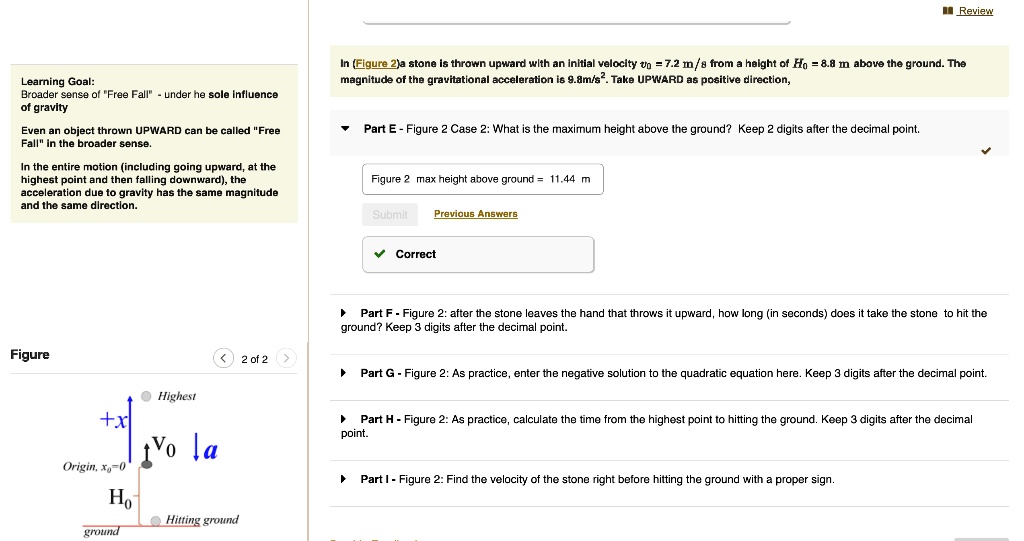
In (Figure 2)a stone is thrown upward with an initial velocity $v_0 = 7.2 \text{ m/s}$ from a height of $H_0 = 8.8 \text{ m}$ above the ground. The
magnitude of the gravitational acceleration is $9.8 \text{m/s}^2$. Take UPWARD as positive direction,
Part E - Figure 2 Case 2: What is the maximum height above the ground? Keep 2 digits after the decimal point.
Figure 2 max height above ground = 11.44 m
Submit Previous Answers
? Correct
Figure
2 of 2 >
Highest
+x
$V_0$ $a$
Origin, $x_0 = 0$
$H_0$
Hitting ground
ground
Part F - Figure 2: after the stone leaves the hand that throws it upward, how long (in seconds) does it take the stone to hit the
ground? Keep 3 digits after the decimal point.
Part G - Figure 2: As practice, enter the negative solution to the quadratic equation here. Keep 3 digits after the decimal point.
Part H - Figure 2: As practice, calculate the time from the highest point to hitting the ground. Keep 3 digits after the decimal
point.
Part I - Figure 2: Find the velocity of the stone right before hitting the ground with a proper sign.