Ace - AI Tutor
Ask Our Educators
Textbooks
My Library
Flashcards
Scribe - AI Notes
Notes & Exams
Download App
daniel martin

daniel m.

Divider

Questions asked

BEST MATCH

Which statement is false regarding ion channels? Intracellular second messengers regulate ion channels. A single neuron normally receives input from many other neurons. Different ions crossing the plasma membrane have different effects on the polarized cell. Neurotransmitter binding only results in depolarization of the target neuron. Action potentials only occur if the integrated input is great enough to depolarize the cell.

View Answer
divider
BEST MATCH

The term meaning removal of the spleen is: splenectomy spleenitis splendotensis spleendary

View Answer
divider
BEST MATCH

Question 36 refers to individual differences in a number of variables that place clients at risk for discrimination A) Multiculturalism B) Diversity C) Cultural tunnel vision D) Countertransference

View Answer
divider
BEST MATCH

Q#2 A large artery can have a diameter of about 0.5 cm, whereas a large vein may have a diameter of about 0.8 cm. The average blood velocity in these arteries and veins is, respectively, on the order of 40 and 20 cm sec$^{-1}$. Calculate for these blood flows the wall shear rate $\frac{dv_z}{dr}$. What would the shear rate be at the centerline of these blood vessels?

View Answer
divider
BEST MATCH

In regards to robotic process automation, a bot is: Osoftware that can perform specific tasks without the need for employee intervention O a way for managers to observe employees performing repetitive tasks O a way to reduce overall errors, but will not improve efficiency O tasks that specific employees perform on a regular basis

View Answer
divider
BEST MATCH

Use the following data to answer problems 4-7: Trans Fat Cholesterol Sodium Burger Calories (g) (mg) (mg) McDonald's Hamburger 250 0.5 25 520 McDonald's Cheeseburger 300 0.5 45 750 McDonald's Quarter Pounder 410 1 65 730 McDonald's Double Quarter Pounder with Cheese 740 2.5 155 1380 McDonald's Big Mac 540 1.5 75 1040 McDonald's Big N' Tasty with Cheese 510 1.5 85 960 Burger King (BK) Whopper with mayo 670 1.5 95 1020 BK Double Whopper with cheese and mayo 990 2.5 195 1520 BK Triple Whopper with cheese & mayo 1230 3.5 275 1590 Wendy's 1/4 lb Single 430 1 75 870 Wendy's 1/2 lb Double with Cheese 710 2 160 1440 Wendy's 3/4 lb Triple with Cheese 980 3.5 245 2010 Wendy's Baconator 840 2.5 195 1880 Arby's Beef and Cheddar 445 1.5 51 1275 Jack in the Box Hamburger Deluxe with Cheese 460 1 70 930 Jack in the Box Bacon Ultimate Cheeseburger 1090 3 140 2040 4. For the calories of each burger: Ia. Find Q1, Q2, Q3, the range and the IQR. b. Calculate the outlier boundaries for the data set. Are there any outliers? c. Determine the value at the 70th percentile.

View Answer
divider
BEST MATCH

Tutorial Exercise Calculate the left Riemann sum for the given function over the given interval using the given value of n. (When rounding, round your answer to four decimal places. If using the tabular method, values of the function in the table should be accurate to at least five decimal places.) f(x) = \frac{2}{1 + x} over [0, 1], n = 5 Step 1 We are asked to calculate the left Riemann sum for $f(x) = \frac{2}{1 + x}$ on the interval $[0, 1]$ with $n = 5$. Recall that the left Riemann over an interval $[a, b]$ sum is given by $\sum_{k=0}^{n-1} f(x_k)\Delta x$, where the points $x_k$ are the endpoints of the subdivisions of the interval in increments of size $\Delta x = \frac{b - a}{n}$. First, we need to find $\Delta x$. $\Delta x = \frac{1 - 0}{5}$ $x_0 = a = 0$ $x_1 = x_0 + \Delta x = \frac{1}{5}$ $x_2 = x_1 + \Delta x = 0.6$ $x_3 = x_2 + \Delta x = 0.8$ $x_4 = x_3 + \Delta x = \frac{4}{5}$

View Answer
divider
BEST MATCH

500 g of medication a in terms of milligrams conversion factor

View Answer
divider
BEST MATCH

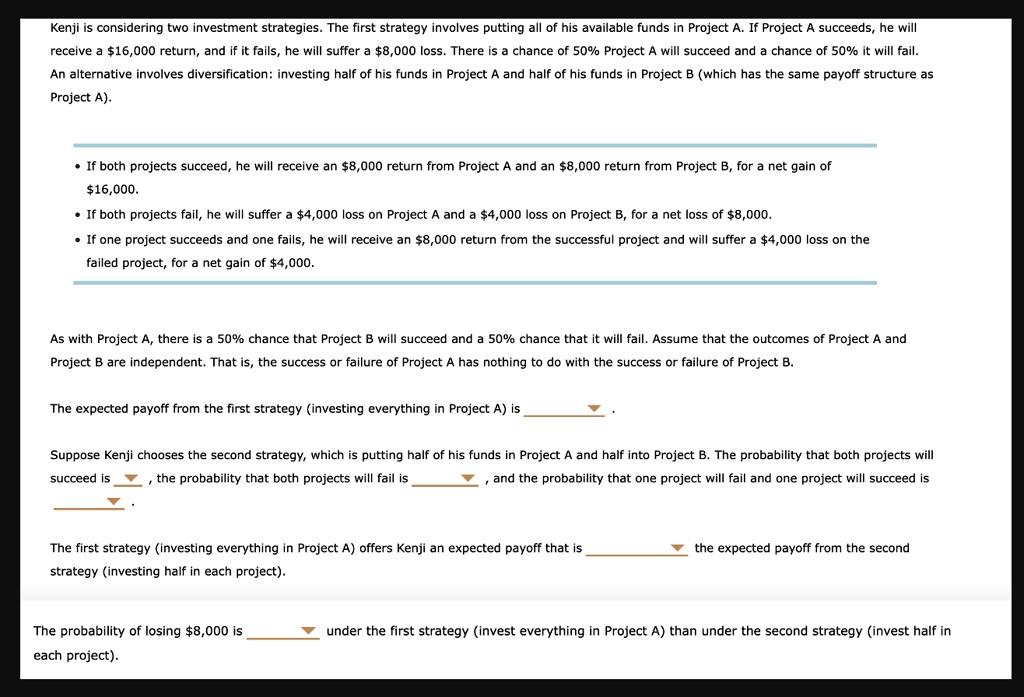
Kenji is considering two investment strategies. The first strategy involves putting all of his available funds in Project A. If Project A succeeds, he will receive a $16,000 return, and if it fails, he will suffer a $8,000 loss. There is a chance of 50% Project A will succeed and a chance of 50% it will fail. An alternative involves diversification: investing half of his funds in Project A and half of his funds in Project B (which has the same payoff structure as Project A). • If both projects succeed, he will receive an $8,000 return from Project A and an $8,000 return from Project B, for a net gain of $16,000. • If both projects fail, he will suffer a $4,000 loss on Project A and a $4,000 loss on Project B, for a net loss of $8,000. • If one project succeeds and one fails, he will receive an $8,000 return from the successful project and will suffer a $4,000 loss on the failed project, for a net gain of $4,000. As with Project A, there is a 50% chance that Project B will succeed and a 50% chance that it will fail. Assume that the outcomes of Project A and Project B are independent. That is, the success or failure of Project A has nothing to do with the success or failure of Project B. The expected payoff from the first strategy (investing everything in Project A) is Suppose Kenji chooses the second strategy, which is putting half of his funds in Project A and half into Project B. The probability that both projects will succeed is the probability that both projects will fail is ?, and the probability that one project will fail and one project will succeed is The first strategy (investing everything in Project A) offers Kenji an expected payoff that is the expected payoff from the second strategy (investing half in each project). The probability of losing $8,000 is under the first strategy (invest everything in Project A) than under the second strategy (invest half in each project).
View Answer
divider
BEST MATCH

? ?) A company receives 1000 integrated circuits (ICs) from supplier A, 2000 ICs from supplier B, and 3000 ICs from supplier C. Probability that an IC is defective is 0.05, 0.10 and 0.10 given that it came from supplier A, B and C respectively. Given that a randomly selected IC is defective, then what is the probability that it came from supplier A, what is the probability that it came from supplier B and what is the probability that it came from supplier C? Suppose an IC is found defective, then from which supplier it would have been more likely to be received?

View Answer
divider