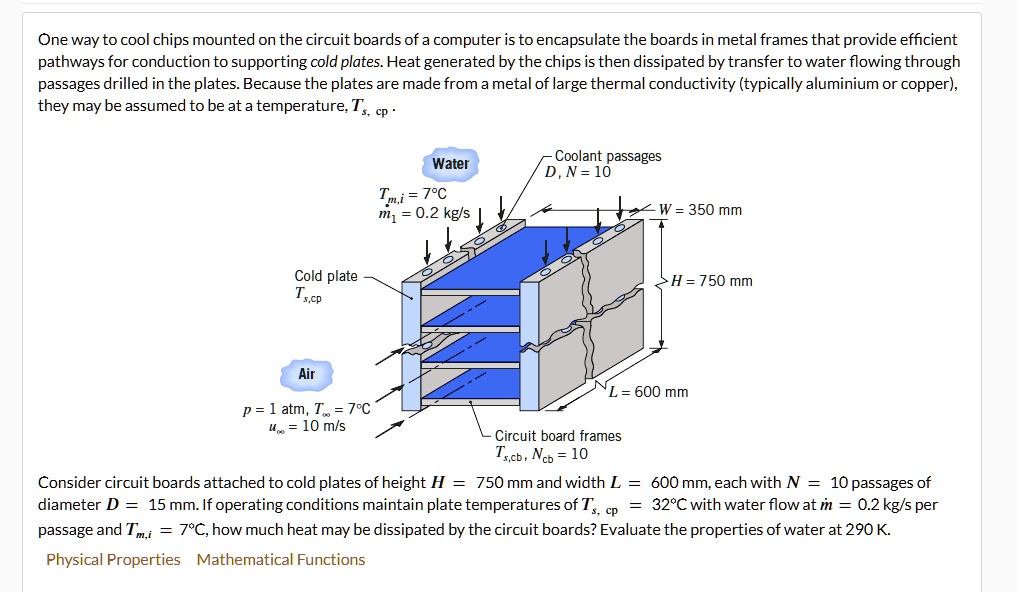
One way to cool chips mounted on the circuit boards of a computer is to encapsulate the boards in metal frames that provide efficient
pathways for conduction to supporting cold plates. Heat generated by the chips is then dissipated by transfer to water flowing through
passages drilled in the plates. Because the plates are made from a metal of large thermal conductivity (typically aluminium or copper),
they may be assumed to be at a temperature, $T_{s, cp}$.
Cold plate
$T_{s,cp}$
Air
$p = 1 \text{ atm}, T_{\infty} = 7^\circ\text{C}$
$u_{\infty} = 10 \text{ m/s}$
Water
Coolant passages
$D, N = 10$
$T_{m,i} = 7^\circ\text{C}$
$m_1 = 0.2 \text{ kg/s}$
$W = 350 \text{ mm}$
$H = 750 \text{ mm}$
$L = 600 \text{ mm}$
Circuit board frames
$T_{s,cb}, N_{cb} = 10$
Consider circuit boards attached to cold plates of height $H = 750 \text{ mm}$ and width $L = 600 \text{ mm}$, each with $N = 10$ passages of
diameter $D = 15 \text{ mm}$. If operating conditions maintain plate temperatures of $T_{s, cp} = 32^\circ\text{C}$ with water flow at $\dot{m} = 0.2 \text{ kg/s}$ per
passage and $T_{m,i} = 7^\circ\text{C}$, how much heat may be dissipated by the circuit boards? Evaluate the properties of water at 290 K.
Physical Properties Mathematical Functions