Ace - AI Tutor
Ask Our Educators
Textbooks
My Library
Flashcards
Scribe - AI Notes
Notes & Exams
Download App
daniel shaw

daniel s.

Divider

Questions asked

BEST MATCH

The tenants of power in the current economic era is: Question 18Select one: A. Capital B. Knowledge C. Buildings D. Ideas E. A and C F. B and D

View Answer
divider
BEST MATCH

Please circle the valid statement(s) for actual steady-operating heat engine cycles: (a) ๐‘†๐‘”๐‘’๐‘› < 0 (b) ๐‘†๐‘”๐‘’๐‘› = 0 (c) ๐‘†๐‘”๐‘’๐‘› > 0 ๏จ (d) The isentropic efficiency of this engine: heat engine , act , isentopic (e) Actual heat engine cycles always involves irreversibility

View Answer
divider
BEST MATCH

Solve the inequality for w. 9-8w<=21-2w Simplify your answer as much as possible

View Answer
divider
BEST MATCH

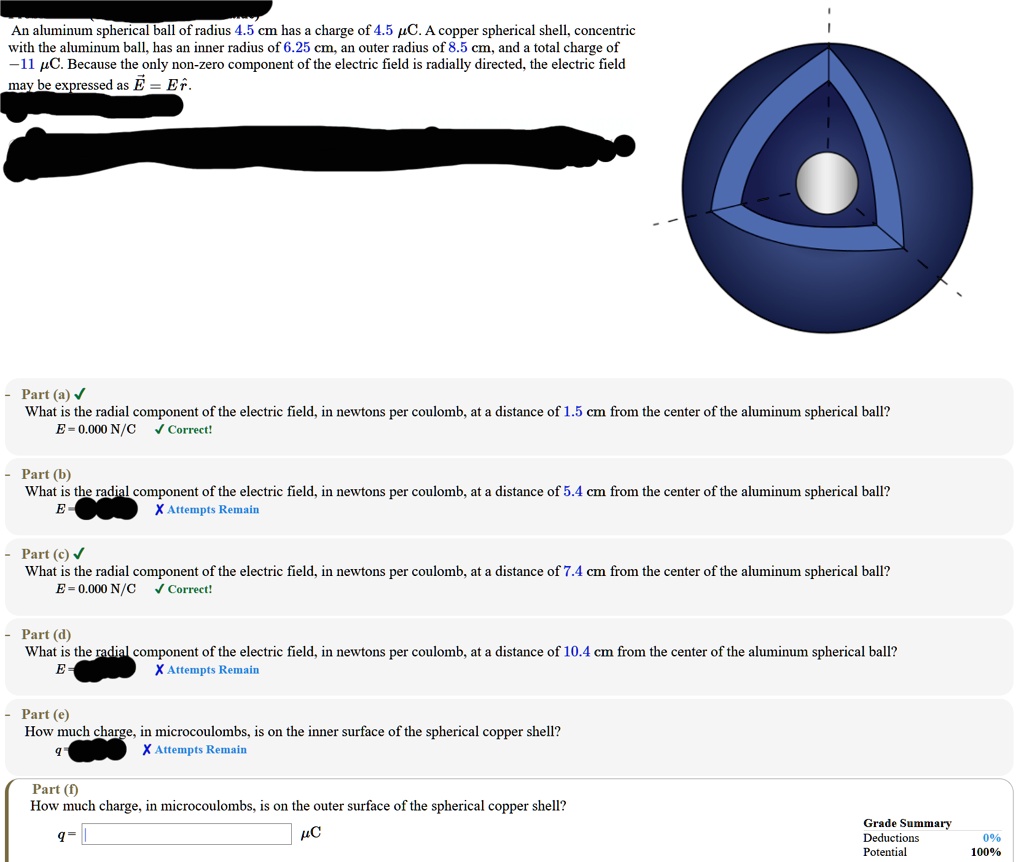
An aluminum spherical ball of radius 4.5 cm has a charge of 4.5 ยตC. A copper spherical shell, concentric with the aluminum ball, has an inner radius of 6.25 cm, an outer radius of 8.5 cm, and a total charge of -11 ยตC. Because the only non-zero component of the electric field is radially directed, the electric field may be expressed as \(\vec{E} = E \hat{r}\). - Part (a) ? What is the radial component of the electric field, in newtons per coulomb, at a distance of 1.5 cm from the center of the aluminum spherical ball? E=0.000 N/C Correct! Part (b) What is the radial component of the electric field, in newtons per coulomb, at a distance of 5.4 cm from the center of the aluminum spherical ball? E- X Attempts Remain Part (c) ? What is the radial component of the electric field, in newtons per coulomb, at a distance of 7.4 cm from the center of the aluminum spherical ball? E = 0.000 N/C ? Correct! Part (d) What is the radial component of the electric field, in newtons per coulomb, at a distance of 10.4 cm from the center of the aluminum spherical ball? E- X Attempts Remain Part (e) How much charge, in microcoulombs, is on the inner surface of the spherical copper shell? q X Attempts Remain Part (f) How much charge, in microcoulombs, is on the outer surface of the spherical copper shell? q= \(\mu C\) Grade Summary Deductions 0% Potential 100%
View Answer
divider
BEST MATCH

Find the following limit or state that it does not exist $\lim_{b \to 2} \frac{9b}{\sqrt{3b + 3} - 1}$ Select the correct choice below and, if necessary, fil

View Answer
divider
BEST MATCH

Which of the following is 2,2-difluoro pentane? A HFHHH ... H-C-C-C-C-C-H HFHHH B HHHHHH H-C-C-C-C-C-C-H F F H H H H C HFHHHH H-C-C-C-C-C-C-H HFHHHH

View Answer
divider
BEST MATCH

Texts: A gas cooling cycle with a pressure ratio of 3 uses helium as a working fluid. The temperature of helium is -10 ยฐC at the compressor inlet and 50 ยฐC at the turbine inlet. Assuming isentropic efficiencies of 80 percent for both the turbine and the compressor, determine a) the minimum temperature in the cycle, b) the coefficient of performance, and c) the mass flow of helium for a cooling load of 18 kW.

View Answer
divider
BEST MATCH

According to AGMA standards, contact stress numbers of pitting resistance for different types of gear teeth are calculated differently. Please select the right formula for each type of gear teeth. Equation a: $s_c = C_p \sqrt{\frac{W_t K_a K_m K_v K_s K_c}{FD_p l}}$ Equation b: $s_c = C_p \sqrt{\frac{W_t K_a K_m K_v K_s C_c C_{xc}}{FD_p l}}$ For helical gears, equation b should be used. For bevel gears, equation b should be used. For helical gears, equation a should be used. For bevel gears, equation a should be used. For spur gears, equation a should be used. For spur gears, equation b should be used.

View Answer
divider
BEST MATCH

BJT: a) Why is the collector-base junction normally reverse biased? b) Why is the emitter doped at a higher concentration than the base? c) What happens if the base is doped at a higher concentration than the emitter? d) Why is the base width small compared to the diffution length of minority carriers in the base? e) As the collector to base reverse bias voltage increases, it is well known that the common emitter current gain changes. Does it go up or down as the reverse bias voltage increases? What is the reason for this? f) In normal mode, what is the majority current type across the base region? MOSFET: a) Why does an n-channel MOSFET have a p-type substrate? b) What polarity of gate voltage with respect to the substrate is required to obtain conduction between drain and source? What happens if the opposite voltage polarity is applied to the gate? c) After the gate has induced a channel, explain how pinchoff occurs as the drain voltage increases. How is the current affected by this?

View Answer
divider
BEST MATCH

(a) Determine the poles of a fifth order Chebychev filter (n = 5) with 1 dB of ripples. (k is 1,2,..5) (b) Draw the poles associated with the fifth order Chebychev filter on a complex plane. (c) Determine the transfer function associated with the fifth order Chebychev filter. (d) Determine the opamp implementation of the fifth order Chebychev filter. You may assume that $f_o$ is equal to 100 kHz. You may assume that 100 nF capacitors are available.

View Answer
divider