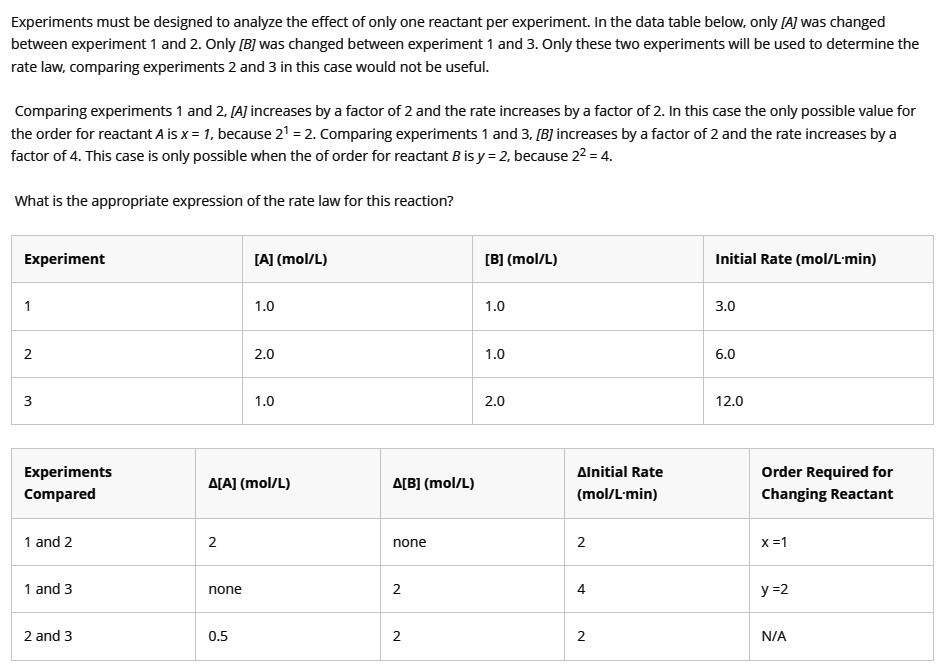
Experiments must be designed to analyze the effect of only one reactant per experiment. In the data table below, only [A] was changed
between experiment 1 and 2. Only [B] was changed between experiment 1 and 3. Only these two experiments will be used to determine the
rate law, comparing experiments 2 and 3 in this case would not be useful.
Comparing experiments 1 and 2, [A] increases by a factor of 2 and the rate increases by a factor of 2. In this case the only possible value for
the order for reactant A is x = 1, because $2^1 = 2$. Comparing experiments 1 and 3, [B] increases by a factor of 2 and the rate increases by a
factor of 4. This case is only possible when the of order for reactant B is y = 2, because $2^2 = 4$.
What is the appropriate expression of the rate law for this reaction?
Experiment
[A] (mol/L)
[B] (mol/L)
Initial Rate (mol/L-min)
1
1.0
1.0
3.0
2
2.0
1.0
6.0
3
1.0
2.0
12.0
Experiments
Compared
?[A] (mol/L)
?[B] (mol/L)
?Initial Rate
(mol/L-min)
Order Required for
Changing Reactant
1 and 2
2
none
2
x =1
1 and 3
none
2
4
y =2
2 and 3
0.5
2
2
N/A