Question 4
15pts
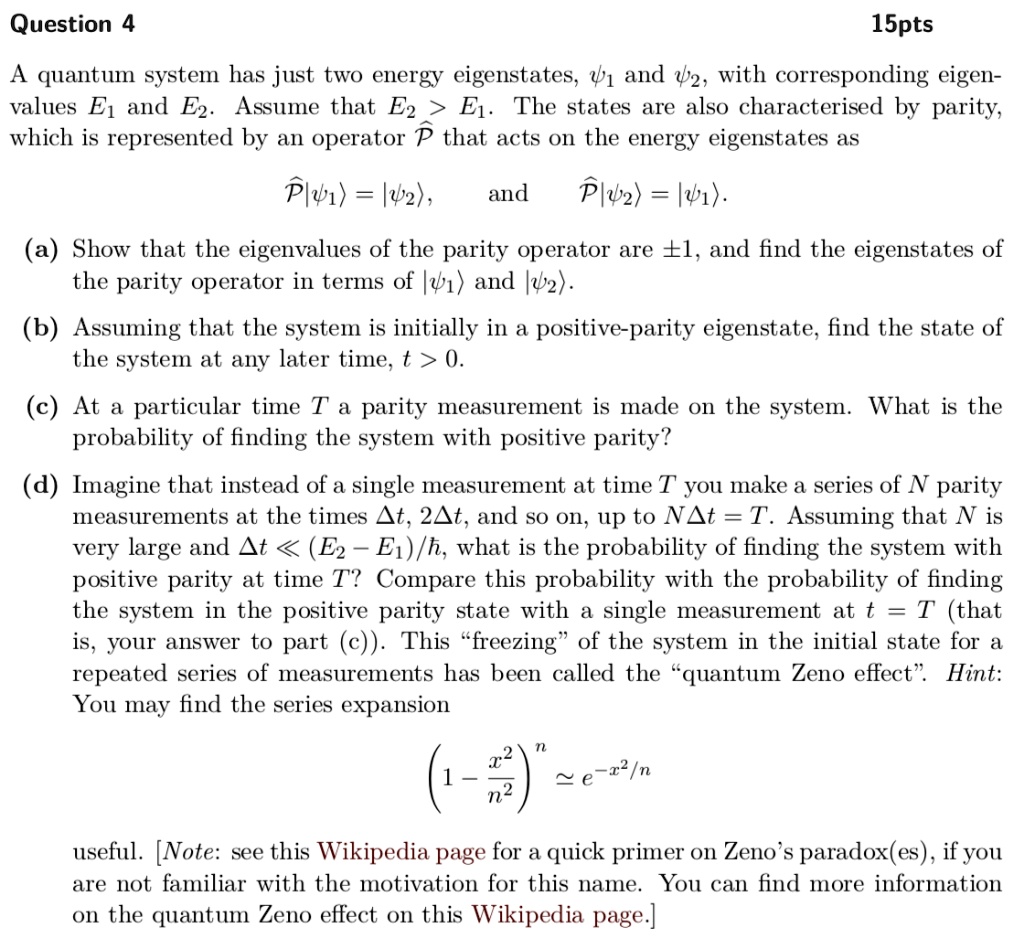
A quantum system has just two energy eigenstates, 1 and 2, with corresponding eigenvalues E1 and E2. Assume that E2 > E1. The states are also characterized by parity, which is represented by an operator P that acts on the energy eigenstates as:
P|1) = |2),
and
P|2) = |1).
(a) Show that the eigenvalues of the parity operator are ±1, and find the eigenstates of the parity operator in terms of |1) and |2).
(b) Assuming that the system is initially in a positive-parity eigenstate, find the state of the system at any later time, t > 0.
(c) At a particular time T, a parity measurement is made on the system. What is the probability of finding the system with positive parity?
(d) Imagine that instead of a single measurement at time T, you make a series of N parity measurements at the times t, 2t, and so on, up to Nt = T. Assuming that N is very large and t < (E2 - E1)/h, what is the probability of finding the system with positive parity at time T? Compare this probability with the probability of finding the system in the positive parity state with a single measurement at t = T (that is, your answer to part (c)). This "freezing" of the system in the initial state for a repeated series of measurements has been called the "quantum Zeno effect". Hint: You may find the series expansion useful. [Note: see this Wikipedia page for a quick primer on Zeno's paradox(es), if you are not familiar with the motivation for this name. You can find more information on the quantum Zeno effect on this Wikipedia page.