Ace - AI Tutor
Ask Our Educators
Textbooks
My Library
Flashcards
Scribe - AI Notes
Notes & Exams
Download App
david wells

david w.

Divider

Questions asked

BEST MATCH

The thalamus is the area where afferent impulses from all senses and all parts of the body are sorted out and then relayed to the appropriate area of the sensory cortex. True False

View Answer
divider
BEST MATCH

name this vessel superior mesenteric artery left renal artery common hepatic artery left gastric artery celiac trunk splenic artery

View Answer
divider
BEST MATCH

create double integrals for the horizontal and vertical cross sections of y=x^(3) and y=27

View Answer
divider
BEST MATCH

A constant-volume calorimeter was calibrated by carrying out a reaction known to release 2.24 kJ of heat in 0.400 L of solution in the calorimeter (q=-2.24kJ), resulting in a temperature rise of 3.76 C. In a subsequent experiment, 200.0mL of 0.30 M HClO2 (aq) and 200.0 mL of 0.30 M NaOH (aq) were mixed in the same calorimeter and the temperature rose by 6.89 C. What is the change in the internal energy of the reaction mixture as a result of the neutralization reaction?

View Answer
divider
BEST MATCH

What is the stereochemical outcome of the following reaction? H$_2$ metal O Anti O Syn O Neither Syn nor Anti O Both Syn and Anti

View Answer
divider
BEST MATCH

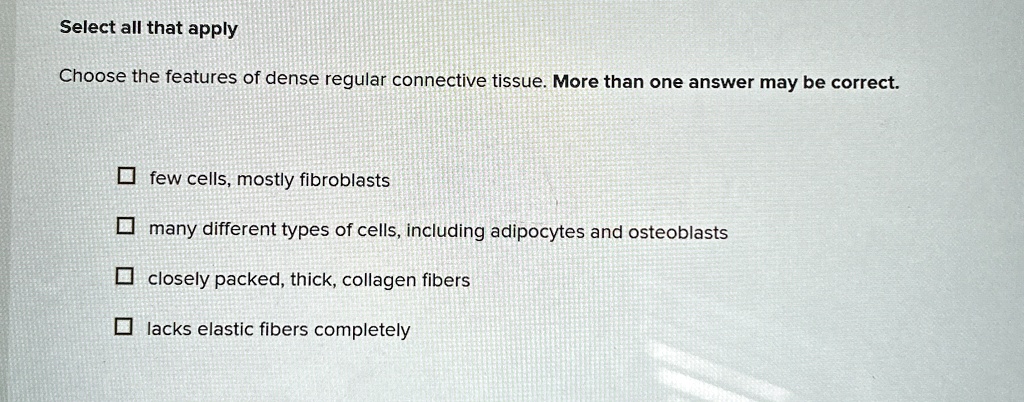
Select all that apply Choose the features of dense regular connective tissue. More than one answer may be correct. ? few cells, mostly fibroblasts ? many different types of cells, including adipocytes and osteoblasts ? closely packed, thick, collagen fibers ? lacks elastic fibers completely
View Answer
divider
BEST MATCH

4. Precisely 20.00 mL of a solution of hydrochloric acid of unknown concentration is placed in a conical flask fitted with a gas-tight stopper and tubing that leads to a container filled with ice- chilled water that is inverted over an ice-water bath (see figure). The stopper is removed and a test tube containing excess solid sodium carbonate is carefully placed inside the flask so that the tube does not fall over. Solid and liquid do not come into contact. The stopper is then re-installed. The sealed flask is then shaken so that liquid and solid completely mix. The reaction below commences and continues until no more gas is produced. The gas product of the reaction displaces 193 mL of water from the inverted gas collection flask. The temperature of the water is 17.0 °C and atmospheric pressure is 0.988 atm. What is the concentration (M) of the hydrochloric acid solution given the vapor pressure of water at 17.0 °C is 14.5 torr. (10 grade points) Show your work below Collection flask Collected gas Water Reaction producing gas $2HCl_{(aq)} + Na_2CO_{3(s)} \rightarrow 2NaCl_{(aq)} + CO_{2(g)} + H_2O_{(l)}$ Universal Gas Constant, R = 0.08206 L atm mol$^{-1}$ K$^{-1}$

View Answer
divider
BEST MATCH

TABLE 16.1 Neuroglia CELL TYPE 1. 2. 3. 4. 5. 6. LOCATION CNS or PNS CNS or PNS CNS or PNS CNS or PNS CNS or PNS CNS or PNS FUNCTION Entire cell forms myelin sheath around a segment of an axon; helps regeneration of axons. Lines four brain ventricles; forms and circulates CSF. Engulfs invading microbes; clears debris; migrates to injured nerves. Maintains environment around neurons; forms blood-brain barrier. Covers sensory neuron cell bodies; maintains neuron environment. Processes from this cell form myelin sheaths around axons.

View Answer
divider
BEST MATCH

3. The slope of the best fit line may look familiar to you. Or at least it is close to a number you have used in homework and tests. Explain the physical significance of the slope and how it relates to Newton's Second Law of motion.

View Answer
divider
BEST MATCH

2. Single Phase Power Calculations (20 Points) Given: • The source voltage is 120 V. • The frequency is 60Hz. • $R_{load} = 4\Omega \ X_L = 3\Omega$. Find: 1. What is the line current if the load is connected in series? 2. What is the real power fed to the resistive load? 3. What is the reactive power fed to the inductive load? 4. Sketch the real and reactive power phase relationship in the complex plane. 5. If you want to correct the power factor what is the value of the parallel capacitor you would need to attach to the load? (Capacitor value not the capacitive reactance.) Explain why. 6. Explain what the real and reactive currents are doing in all three components by drawing the circuit and labeling the currents.

View Answer
divider