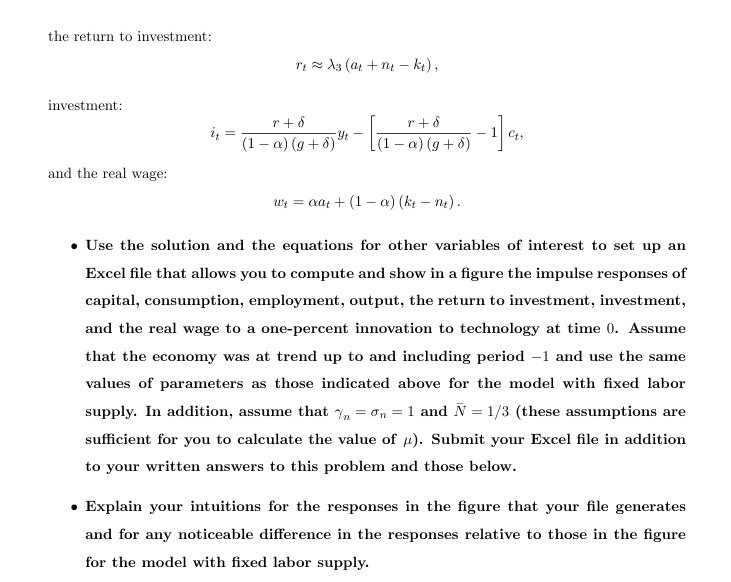
the return to investment:
$r_t \approx \lambda_3 (a_t + n_t - k_t)$,
investment:
$i_t = \frac{r + \delta}{(1 - \alpha)(g + \delta)} y_t - \left[ \frac{r + \delta}{(1 - \alpha)(g + \delta)} - 1 \right] c_t$,
and the real wage:
$w_t = \alpha a_t + (1 - \alpha)(k_t - n_t)$.
• Use the solution and the equations for other variables of interest to set up an
Excel file that allows you to compute and show in a figure the impulse responses of
capital, consumption, employment, output, the return to investment, investment,
and the real wage to a one-percent innovation to technology at time 0. Assume
that the economy was at trend up to and including period -1 and use the same
values of parameters as those indicated above for the model with fixed labor
supply. In addition, assume that $\gamma_n = \sigma_n = 1$ and $N = 1/3$ (these assumptions are
sufficient for you to calculate the value of $\mu$). Submit your Excel file in addition
to your written answers to this problem and those below.
• Explain your intuitions for the responses in the figure that your file generates
and for any noticeable difference in the responses relative to those in the figure
for the model with fixed labor supply.