Ace - AI Tutor
Ask Our Educators
Textbooks
My Library
Flashcards
Scribe - AI Notes
Notes & Exams
Download App
Zheng Xiaoqing

Zheng X.

Divider

Viewed Questions

An anisotropic material has coefficients of linear thermal expansion $\alpha_{1}, \alpha_{2}$ and $\alpha_{3}$ along $x, y$ and $z$ -axis respectively. Coefficient of cubical expansion of its material will be equal to
(a) $\alpha_{1}+\alpha_{2}+\alpha_{3}$
(b) $\alpha_{1}+2 \alpha_{2}+3 \alpha_{3}$
(c) $3 \alpha_{1}+2 \alpha_{2}+\alpha_{3}$
(d) $\frac{\alpha_{1}+\alpha_{2}+\alpha_{3}}{3}$

An anisotropic material has coefficients of linear thermal expansion $\alpha_{1}, \alpha_{2}$ and $\alpha_{3}$ along $x, y$ and $z$ -axis respectively. Coefficient of cubical expansion of its material will be equal to (a) $\alpha_{1}+\alpha_{2}+\alpha_{3}$ (b) $\alpha_{1}+2 \alpha_{2}+3 \alpha_{3}$ (c) $3 \alpha_{1}+2 \alpha_{2}+\alpha_{3}$ (d) $\frac{\alpha_{1}+\alpha_{2}+\alpha_{3}}{3}$

Objective Physics for NEET

Questions asked

ANSWERED

Khaled Yasein verified

Numerade educator

A harmonic oscillator of frequency ( omega ) is in the state ( psi=left(psi_{0}-sqrt{2} psi_{1} ight) / sqrt{3} ) where ( psi_{0} ) and ( psi_{1} ) are energy eigenstates. A. If the energy of the oscillator is measured, what are the possible outcomes and the corresponding probabilities? B. Calculate ( langle x angle ) and ( leftlangle x^{2} ight angle ). C. Calculate ( langle p angle ) and ( leftlangle p^{2} ight angle ). D. Show that the state ( psi ) satisfies the uncertainty principle. Useful integrals: [ egin{aligned} int_{-infty}^{infty} e^{-x^{2}} d x &=sqrt{pi} \ int_{-infty}^{infty} x^{2} e^{-x^{2}} d x &=frac{1}{2} sqrt{pi} \ int_{-infty}^{infty} x^{4} e^{-x^{2}} d x &=frac{3}{4} sqrt{pi} end{aligned} ]

View Answer
divider
INSTANT ANSWER

Light from a green laser pointer has a wavelength of \( 532 \mathrm{~nm} \). The light illuminates two narrow slits separated by a distance \( d \). The figure below shows the phasor diagram for a point \( P \) on a wall \( 2.00 \mathrm{~m} \) from the slits. The point \( P \) is \( 21.4 \mathrm{~cm} \) from the central maximum and is located between the \( m=0 \) and \( m=1 \) maxima. The intensity of the light at \( P \) is \( 2.67 \times 10^{-6} \mathrm{~W} / \mathrm{m}^{2} \). Through painstaking work and with incredible technological prowess, you add a third slit so that you now have three equally spaced identical slits with separation \( d \). What is the intensity of the light at point P and at the central maximum?

View Answer
divider
ANSWERED

Khoobchandra Agrawal verified

Numerade educator

Derive the intensity formula for two-slit interference. The wavelength of the light illuminating the slits is ( lambda ). The distance to the screen is large, so you can assume the two rays follow parallel paths to point P on the screen.

View Answer
divider
ANSWERED

Linda Winkler verified

Numerade educator

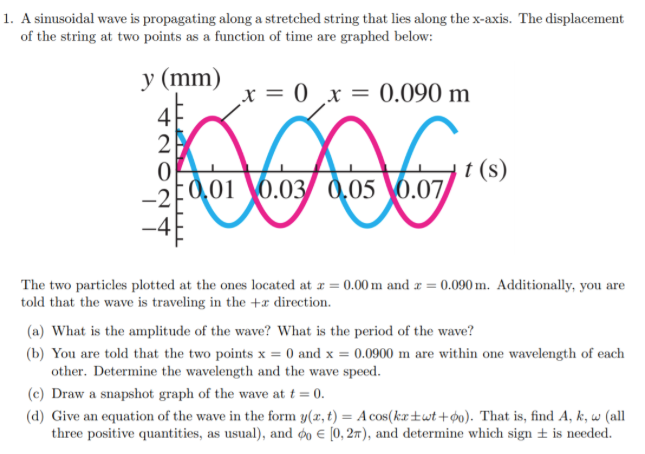
1. A sinusoidal wave is propagating along a stretched string that lies along the x-axis. The displacement of the string at two points as a function of time are graphed below: The two particles plotted at the ones located at x = 0.00 m and x = 0.090 m. Additionally, you are told that the wave is traveling in the +x direction. (a) What is the amplitude of the wave? What is the period of the wave? (b) You are told that the two points x = 0 and x = 0.0900 m are within one wavelength of each other. Determine the wavelength and the wave speed. (c) Draw a snapshot graph of the wave at t = 0. (d) Give an equation of the wave in the form y(x, t) = A cos(kx ± ?t + ?0). That is, find A, k, ? (all three positive quantities, as usual), and ?0 ? [0, 2?), and determine which sign ± is needed.
View Answer
divider
INSTANT ANSWER

A hydrogen atom in a \( 3 d \) state emits a photon when the electron transitions to a lower-energy state. In the absence of a magnetic field, what are the possible wavelengths of the photon? The atom is then placed in a strong magnetic field in the z-direction. Ignore spin effects; consider only the interaction of the magnetic field with the atom's orbital magnetic moment. How many different photon wavelengths are observed? Which transitions lead to the photons with the shortest wavelength?

View Answer
divider