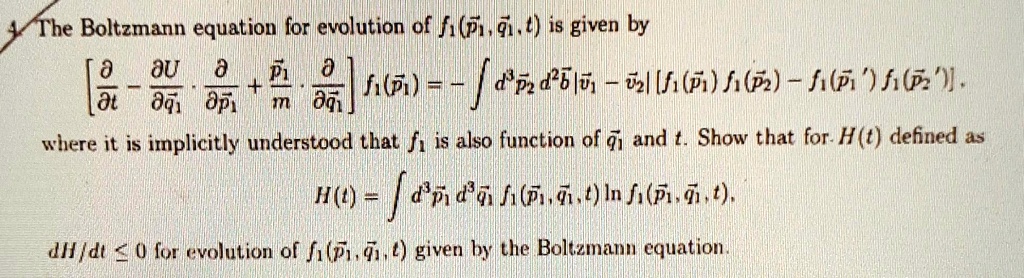
The Boltzmann equation for evolution of $f_1(\vec{p}_1, \vec{q}_1, t)$ is given by
$\left[\frac{\partial}{\partial t} - \frac{\partial U}{\partial \vec{q}_1} \cdot \frac{\partial}{\partial \vec{p}_1} + \frac{\vec{p}_1}{m} \cdot \frac{\partial}{\partial \vec{q}_1}\right] f_1(\vec{p}_1) = - \int d^3 \vec{p}_2 d^2 \vec{b} |\vec{v}_1 - \vec{v}_2| [f_1(\vec{p}_1) f_1(\vec{p}_2) - f_1(\vec{p}_1') f_1(\vec{p}_2')]$
where it is implicitly understood that $f_1$ is also function of $\vec{q}_1$ and t. Show that for $H(t)$ defined as
$H(t) = \int d^3 \vec{p}_1 d^3 \vec{q}_1 f_1(\vec{p}_1, \vec{q}_1, t) \ln f_1(\vec{p}_1, \vec{q}_1, t)$,
$dH/dt \le 0$ for evolution of $f_1(\vec{p}_1, \vec{q}_1, t)$ given by the Boltzmann equation.