Q1. A)Define;
i) Fluid, Vorticity, absolute and effective pressures, Non-Newtonian Fluid, Irrotational flow.
ii) Difference between the Euler and Navier-Stoke's Equations,
iii) Difference between Integral and Differential Forms of the Princibles in Fluid Mechanics
iv) Important of the dimensional analysis in fluid mechanics
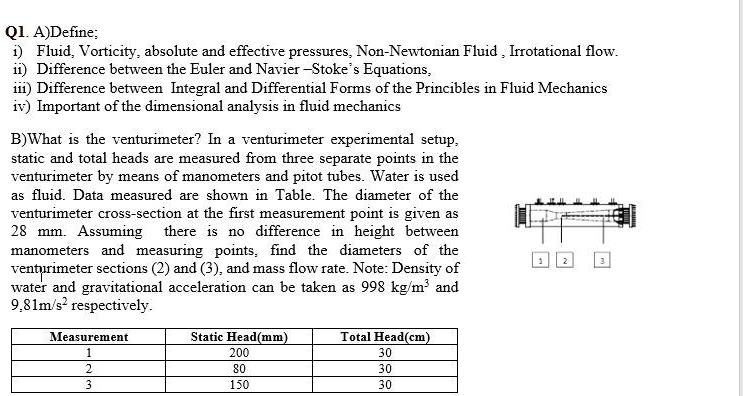
B)What is the venturimeter? In a venturimeter experimental setup,
static and total heads are measured from three separate points in the
venturimeter by means of manometers and pitot tubes. Water is used
as fluid. Data measured are shown in Table. The diameter of the
venturimeter cross-section at the first measurement point is given as
28 mm. Assuming there is no difference in height between
manometers and measuring points, find the diameters of the
venturimeter sections (2) and (3), and mass flow rate. Note: Density of
water and gravitational acceleration can be taken as 998 kg/m³ and
9,81m/s² respectively.
Measurement
Static Head(mm)
Total Head(cm)
1
200
30
2
80
30
3
150
30