Questions asked
To estimate the mean score $\mu$ of those who took the Medical College Admission Test on your campus, you will obtain the scores of an SRS of students. From published information you know that the scores are approximately Normal with standard deviation about 6.3. You want your sample mean $\bar{x}$ to estimate $\mu$ with an error of no more than 1 point in either direction. How large an SRS do you need in order to reduce the standard deviation of $\bar{x}$ to the value you found? Give your answer rounded up to the nearest whole number. SRS size:
The Concorde was a supersonic aircraft used for trans-Atlantic travel in the 1980s and 1990s, having a length of 61.0 m when sitting on the ground on a typical day when the temperature is 14.0 ∘C . The Concorde is primarily made of aluminum. In flight at twice the speed of sound, friction with the air warms the Concorde's skin and causes the aircraft to lengthen by 30.0 cm . (The passenger cabin is on rollers, so the airplane expands around the passenger cabin.) Take the coefficient of linear expansion for aluminum to be α = 2.40×10⁻⁵ /∘C . Part A What is the temperature T of the Concorde's skin in flight? View Available Hint(s)
When someone may be at risk, coping strategies and support occur at which of the following levels: Medical and mental health providers Friends, family, and caring contacts Self All of the above
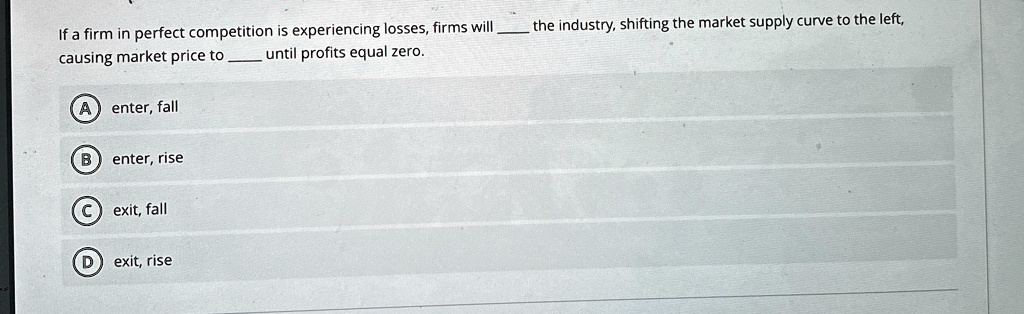
If a firm in perfect competition is experiencing losses, firms will __the industry, shifting the market supply curve to the left, causing market price to __ until profits equal zero. A enter, fall B enter, rise C exit, fall D exit, rise
Assume there is a decrease in demand and an increase in supply. Which of the following statements is correct? The equilibrium price will definitely increase. The equilibrium price will definitely decrease. The equilibrium quantity will definitely increase. The equilibrium quantity will definitely decrease.
The production of new ideas in the Romer model Select one: Oa. increases in the efficiency of creating knowledge and the fraction of labor in research and development. Ob. decreases in the efficiency of creating knowledge and increasing the fraction of labor in research and development. Oc. increases in the efficiency of creating knowledge and decreasing in the fraction of labor in research and development. Od. increases in the population growth rate and capital accumulation. Oe. decreases in the efficiency of creating knowledge and in the fraction of labor in research and development.
Let $f(t) = \frac{\sqrt{3}}{t^7}$. Then, $f'(t) = $ $f'(2) = $
QUESTION 8 Which tissue would you expect to be the thickest? A. Simple cuboidal B. Simple squamous C. Simple columnar D. Stratified columnar
Find the vector in the subspace W spanned by $\begin{bmatrix} -4\\1\\-4\\-3 \end{bmatrix}$, $\begin{bmatrix} -1\\5\\0\\-4 \end{bmatrix}$ which is closest to $\begin{bmatrix} 9\\8\\8\\-2 \end{bmatrix}$
1. Acid reflux occurs if this structure is compromised. A. HCl & intrinsic factor for B12 absorption. 2. Function of secretin. B. external sphincter. C. ileum. D. duodenum. 3. Why chemotherapy causes nausea & vomiting. 4. Stores bile. 5. Connects stomach's lesser curvature to liver. E. cardiac sphincter. 6. Function of vasoactive intestinal peptide (VIP). F. cholecystokinin. G. pancreas. H. hepatic-portal vein. 7. Tightening of pyloric sphincter to delay emptying. 8. Secreted by parietal cells of stomach. 9. Special blood route delivering nutrients to liver. I. protein-digesting enzyme in inactive form. 10. Anticoagulant produced in liver. 11. Hormone that stimulates gastric glands. J. peristalsis. K. lysozyme. 12. Where appendix is found. 13. Stimulates enzyme-rich pancreatic juice release. L. increase production of HCO3. M. lesser omentum. N. Dilates blood vessels of intestines. O. heparin. P. defensin. 14. Produces gastrin & cholecystokinin. 15. Distention of intestine will elicit this reaction. 16. Emulsifier of fat. 17. Allows convenient control of elimination. Q. Neural. 18. Causes brown coloration of feces. R. Enteroendocrine cells. 19. Latter 2 divisions of the small intestine. S. zymogenic cells (used 2x). T. Treatment destroys rapidly dividing cells. 20. Folds of stomach submucosa. 21. Another name for chief cells. U. gallbladder. 22. Pepsinogen is. V. cecum. 23. Paneth cells secrete these (2). W. Bile. 24. Cephalic & gastric phase controlling secretions are also known as. X. gastrin. Y. urobilinogen. 25. Makes bile. Z. Jejunum. 26. First foot of the small intestine. AA. rugae. 27. Exocrine & endocrine organ. BB. liver. 28. Rhythmic wave of muscle contraction. CC. enteroendocrine reflex (used 2x). 29. Produces pepsinogen. DD. hormonal.