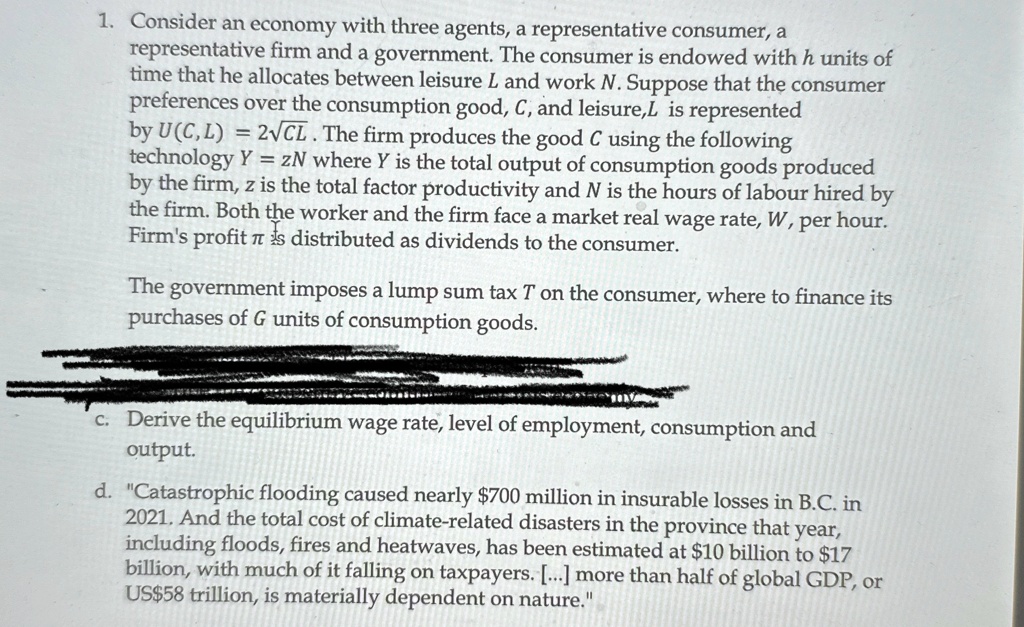
1. Consider an economy with three agents, a representative consumer, a
representative firm and a government. The consumer is endowed with h units of
time that he allocates between leisure L and work N. Suppose that the consumer
preferences over the consumption good, C, and leisure,L is represented
by $U(C, L) = 2\sqrt{CL}$. The firm produces the good C using the following
technology $Y = zN$ where Y is the total output of consumption goods produced
by the firm, z is the total factor productivity and N is the hours of labour hired by
the firm. Both the worker and the firm face a market real wage rate, W, per hour.
Firm's profit $\pi$ is distributed as dividends to the consumer.
The government imposes a lump sum tax T on the consumer, where to finance its
purchases of G units of consumption goods.
c. Derive the equilibrium wage rate, level of employment, consumption and
output.
d. "Catastrophic flooding caused nearly $700 million in insurable losses in B.C. in
2021. And the total cost of climate-related disasters in the province that year,
including floods, fires and heatwaves, has been estimated at $10 billion to $17
billion, with much of it falling on taxpayers. [...] more than half of global GDP, or
US$58 trillion, is materially dependent on nature."