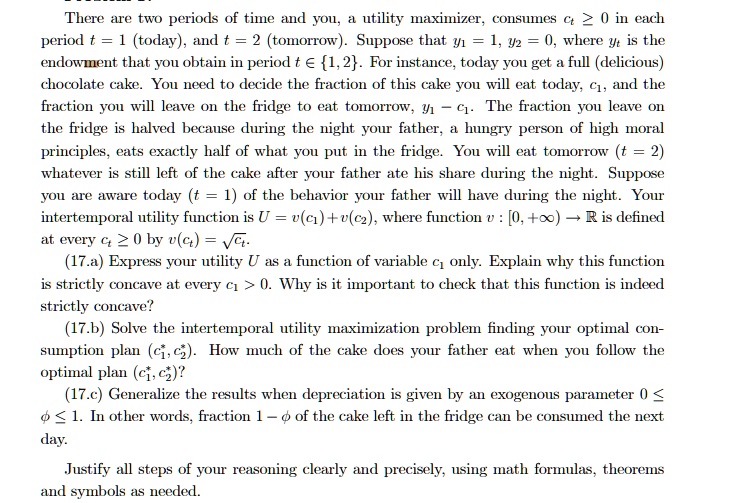
There are two periods of time and you, a utility maximizer, consumes ct > 0 in each period t =1 (today), and t =2 (tomorrow). Suppose that y1 =1, 2 =0, where yt is the endowment that you obtain in period t {1,2}. For instance, today you get a full (delicious)
chocolate cake. You need to decide the fraction of this cake you will eat today, c, and the fraction you will leave on the fridge to eat tomorrow, i - ci. The fraction you leave on the fridge is halved because during the night your father, a hungry person of high moral principles, eats exactly half of what you put in the fridge. You will eat tomorrow (t = 2) whatever is still left of the cake after your father ate his share during the night. Suppose you are aware today (t = 1) of the behavior your father will have during the night. Your intertemporal utility function is U = (c)+ (c2), where function v : [0, +) R is defined at every ct 0 by (ct) = /ct 17.a) Express vour utility U as a function of variable c only. Explain why this function is strictly concave at every ci > 0. Why is it important to check that this function is indeed strictly concave? (17.b) Solve the intertemporal utility maximization problem finding your optimal con- sumption plan (c*,c*). How much of the cake does your father eat when you follow the optimal plan (c*, c*)? (17.c) Generalize the results when depreciation is given by an exogenous parameter 0 < 1. In other words, fraction 1 - of the cake left in the fridge can be consumed the next
day.
Justify all steps of your reasoning clearly and precisely, using math formulas, theorems
and symbols as needed.