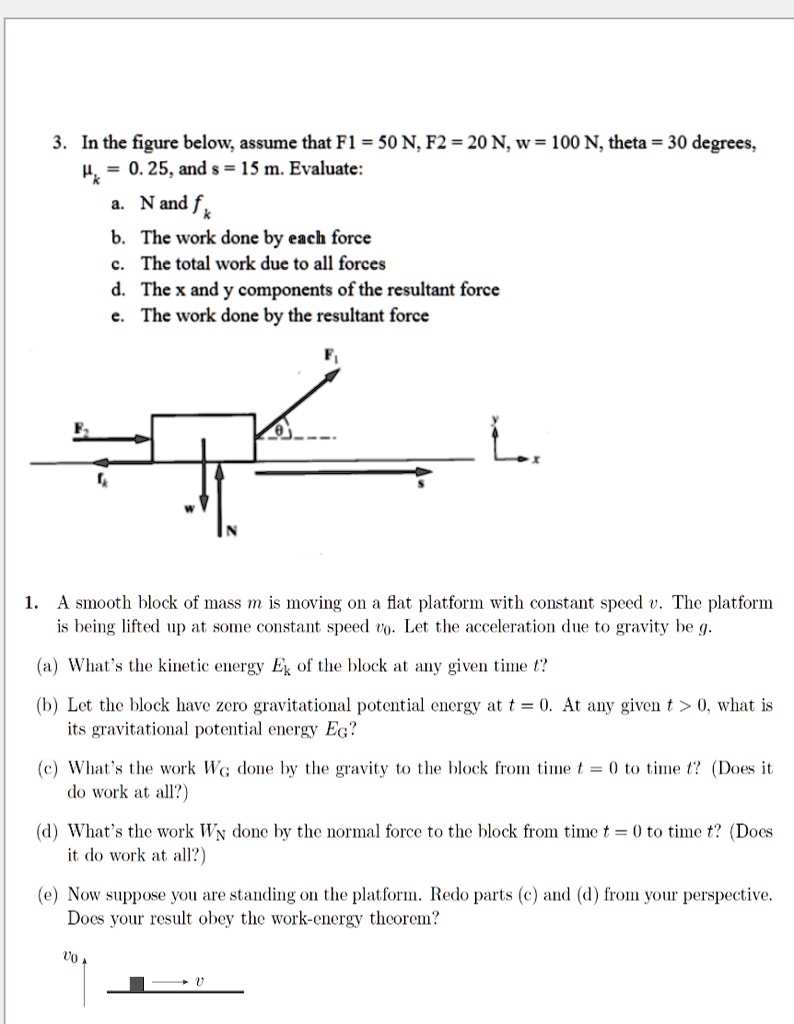
3. In the figure below, assume that F1 = 50 N, F2 = 20 N, w = 100 N, theta = 30 degrees, \mu_k = 0.25, and s = 15 m. Evaluate:
a. N and $f_k$
b. The work done by each force
c. The total work due to all forces
d. The x and y components of the resultant force
e. The work done by the resultant force
1. A smooth block of mass m is moving on a flat platform with constant speed v. The platform is being lifted up at some constant speed $v_0$. Let the acceleration due to gravity be g.
(a) What's the kinetic energy $E_k$ of the block at any given time t?
(b) Let the block have zero gravitational potential energy at t = 0. At any given t > 0, what is its gravitational potential energy $E_G$?
(c) What's the work $W_G$ done by the gravity to the block from time t = 0 to time t? (Does it do work at all?)
(d) What's the work $W_N$ done by the normal force to the block from time t = 0 to time t? (Does it do work at all?)
(e) Now suppose you are standing on the platform. Redo parts (c) and (d) from your perspective. Does your result obey the work-energy theorem?
$v_0$
$v$