Ace - AI Tutor
Ask Our Educators
Textbooks
My Library
Flashcards
Scribe - AI Notes
Notes & Exams
Download App
Foster James

Foster J.

Divider

Questions asked

ANSWERED

Rasha Ismaiel verified

Numerade educator

A fancy sports car moves past an observer on a corner at a speed of 0.6 c. When the observer indicates a one-second interval has passed, what time interval will be shown on the driver’s watch?

View Answer
divider
ANSWERED

Khaled Yasein verified

Numerade educator

2) Dirac notation and the Hamiltonian operator: Consider the Hamiltonian ( H ) of a particle in a one dimensional problem defined by: [ H=frac{1}{2 m} P^{2}+V(X) ] where ( X ) and ( P ) are the position and momentum operators defined in class (recall the commutation relation for these two operators!!). The eigenvectors of ( H ) are denoted as ( left|phi_{n} ight angle ) such at ( Hleft|phi_{n} ight angle=E_{n}left|phi_{n} ight angle ), where ( n ) is a discrete index. a) By considering the commutator ( [X, H] ), show that, [ leftlanglephi_{n}|P| phi_{n^{prime}} ight angle=alphaleftlanglephi_{n}|X| phi_{n^{prime}} ight angle ] where ( alpha ) is a coefficient which depends on the difference between ( E_{n} ) and ( E_{n^{prime}} ). b) Using closure, deduce the following relation, [ sum_{n^{prime}}left(E_{n}-E_{n^{prime}} ight)^{2}left|leftlanglephi_{n}|X| phi_{n^{prime}} ight angle ight|^{2}=frac{hbar^{2}}{m^{2}}leftlanglephi_{n}left|P^{2} ight| phi_{n} ight angle ]

View Answer
divider
ANSWERED

Juan Nicolás verified

Numerade educator

Discuss how online shopping app similar to app Shopee could impact to the profit context.

View Answer
divider
ANSWERED

Neelesh Sharma verified

Numerade educator

This question looks at the rotation spectrum for carbon monoxide, CO. The molecule is first treated as a rigid rod with a moment of inertia I ~ 1.5 × 10??? kgm² about axes perpendicular to its length, and zero parallel to its length. a. What is the energy E? and degeneracy D? of a general eigenstate with angular momentum quantum number J? b. What is the spacing between the levels in terms of J? Sketch the position of the levels with J = 0, 1 and 2, labeling their degeneracy and spacing. c. Explain in one or two sentences the origin of the selection rule ?J = ±1 for absorption of electromagnetic radiation (in the dipole approximation). The thermal occupation of the energy levels is proportional their degeneracy D? multiplied by the Boltzmann weight e???/???. d. Sketch the absorption spectrum as a function of energy for rotational excitations of CO. For CO the ratio of the energies of the 6th absorption to the 1st absorption line is found experimentally to be 5.9988. The difference from 6 is attributed to the stretching of the molecule. e. From this difference, estimate the vibration frequency of the CO bond to a precision of one significant figure. [? ~ 1.0 × 10?³? Js?¹]

View Answer
divider
BEST MATCH

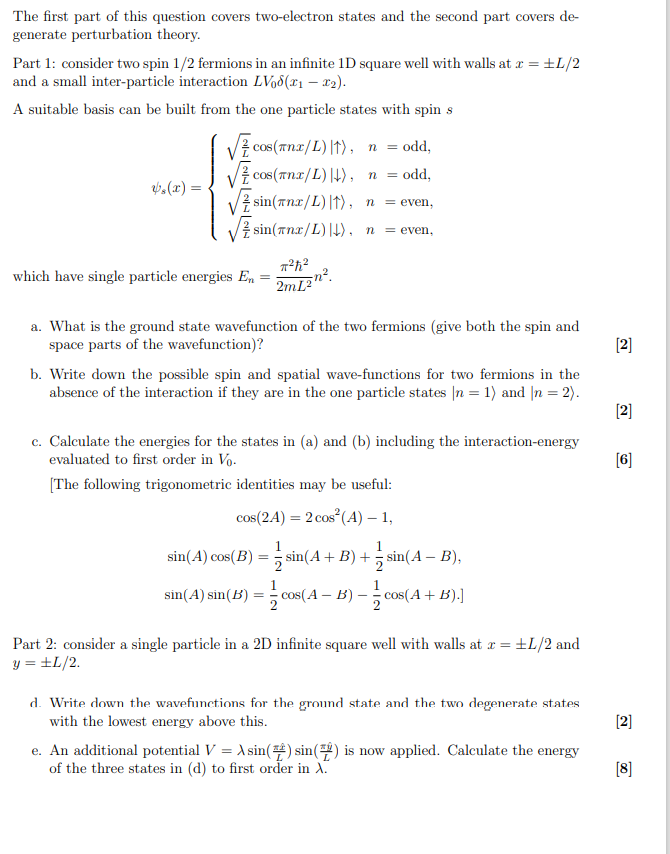
The first part of this question covers two-electron states and the second part covers degenerate perturbation theory. Part 1: consider two spin \( 1 / 2 \) fermions in an infinite 1D square well with walls at \( x=\pm L / 2 \) and a small inter-particle interaction \( L V_{0} \delta\left(x_{1}-x_{2}\right) \). A suitable basis can be built from the one particle states with spin \( s \) \[ \psi_{s}(x)=\left\{\begin{array}{ll} \sqrt{\frac{2}{L}} \cos (\pi n x / L)|\uparrow\rangle, & n=\text { odd }, \\ \sqrt{\frac{2}{L}} \cos (\pi n x / L)|\downarrow\rangle, & n=\text { odd }, \\ \sqrt{\frac{2}{L}} \sin (\pi n x / L)|\uparrow\rangle, & n=\text { even }, \\ \sqrt{\frac{2}{L}} \sin (\pi n x / L)|\downarrow\rangle, & n=\text { even }, \end{array}\right. \] which have single particle energies \( E_{n}=\frac{\pi^{2} \hbar^{2}}{2 m L^{2}} n^{2} \). a. What is the ground state wavefunction of the two fermions (give both the spin and space parts of the wavefunction)? \( [2] \) b. Write down the possible spin and spatial wave-functions for two fermions in the absence of the interaction if they are in the one particle states \( |n=1\rangle \) and \( |n=2\rangle \). \( [2] \) c. Calculate the energies for the states in (a) and (b) including the interaction-energy evaluated to first order in \( V_{0} \). [The following trigonometric identities may be useful: \[ \begin{array}{c} \cos (2 A)=2 \cos ^{2}(A)-1, \\ \sin (A) \cos (B)=\frac{1}{2} \sin (A+B)+\frac{1}{2} \sin (A-B), \\ \left.\sin (A) \sin (B)=\frac{1}{2} \cos (A-B)-\frac{1}{2} \cos (A+B) .\right] \end{array} \] \( [6] \) Part 2: consider a single particle in a \( 2 \mathrm{D} \) infinite square well with walls at \( x=\pm L / 2 \) and \( y=\pm L / 2 \). d. Write down the wavefunctions for the ground state and the two degenerate states with the lowest energy above this. \( [2] \) e. An additional potential \( V=\lambda \sin \left(\frac{\pi \hat{x}}{L}\right) \sin \left(\frac{\pi \hat{y}}{L}\right) \) is now applied. Calculate the energy of the three states in (d) to first order in \( \lambda \). [8]
View Answer
divider
INSTANT ANSWER

C.1 This question is on non-degenerate perturbation theory. a. Derive the second order non-degenerate perturbation theory result, that a small perturbing potential \( \lambda V(\hat{x}) \) shifts the energy levels from their unperturbed values \( \epsilon_{n} \) by \[ E_{n}-\epsilon_{n}=\langle n|\hat{V}| n\rangle \lambda+\sum_{i \neq n} \frac{|\langle i|\hat{V}| n\rangle|^{2}}{\epsilon_{n}-\epsilon_{i}} \lambda^{2}+O\left[\lambda^{3}\right] \] Consider a charged particle of charge \( q \) and mass \( m \) attached to a spring of spring constant \( K=m \omega^{2} \). The Hamiltonian is \[ \hat{H}=\frac{\hat{p}^{2}}{2 m}+\frac{m \omega^{2}}{2} \hat{x}^{2}, \] with \( x \) the displacement from equilibrium. This Hamiltonian can be rewritten as \[ \hat{H}=\left(\frac{1}{2}+\hat{a}^{+} \hat{a}^{-}\right) \hbar \omega \] with ladder (raising and lowering) operators \[ \begin{array}{l} \hat{a}^{+}=\sqrt{\frac{m \omega}{2 \hbar}} \hat{x}-i \sqrt{\frac{1}{2 m \hbar \omega}} \hat{p} \\ \hat{a}^{-}=\sqrt{\frac{m \omega}{2 \hbar}} \hat{x}+i \sqrt{\frac{1}{2 m \hbar \omega}} \hat{p} \end{array} \] The eigenstates have energies \( \epsilon_{n}=\left(\frac{1}{2}+n\right) \hbar \omega \) and are denoted \( |n\rangle \) with integer \( n= \) \( 0,1,2 \cdots \). The raising and lowering operators act on the eigenstates thus: \[ \begin{aligned} \hat{a}^{+}|n\rangle &=\sqrt{n+1}|n+1\rangle, \\ \hat{a}^{-}|n\rangle &=\left\{\begin{array}{ll} \sqrt{n}|n-1\rangle, & (n>0) \\ 0, & (n=0) \end{array}\right. \end{aligned} \] b. Use perturbation theory to show that the energy of the ground state of the harmonic oscillator in the presence of a perturbation \( \hat{H}_{1}=\lambda \hat{x} \) up to second order in \( \lambda \) is \[ E_{0}=\frac{\hbar \omega_{0}}{2}-\frac{\lambda^{2}}{2 m \omega^{2}} \] c. By considering \( \hat{a}|0\rangle=0 \) or otherwise show that the unperturbed ground state wavefunction is \( \langle x \mid 0\rangle \propto e^{-\lambda x^{2}} \) with \( \lambda=\frac{m \omega}{2 \hbar} \). [5]

View Answer
divider
ANSWERED

Frank Deng verified

Numerade educator

Consider a particle with angular momentum ( j=1 ). (a) Write down the three basis states which are eigenvectors of ( J_{z} ) in both Dirac notation and as vectors. [1] (b) Write the matrices for the operators ( J^{2}, J_{+}, J_{-}, J_{x}, J_{y} ), and ( J_{z} ). Which of these operators are Hermitian? ( [15] ) (c) Which operators in part ( (b) ) form a complete set of commuting observables? [1] (d) Consider the Hamiltonian ( H=alpha J_{z} ) ( ( alpha ) is a real number). What are the energy eigenvalues and eigenvectors? ( [2] ) (e) What are the energy eigenvalues and eigenvectors for the case of a particle with angular momentum ( j=frac{1}{2} ) ? [1]

View Answer
divider
INSTANT ANSWER

Show the following properties of ladder operators acting on the eigenstates of the number operator \( ( \) ie \( |n\rangle) \). (a) \( [a, N]=a \). [2] (b) \( N a^{3}|n\rangle=(n-3) a^{3}|n\rangle \). Consider the Hamiltonian \( H=\hbar \omega\left(N+\frac{1}{2}\right) \), where \( N \) is the number operator. (c) Using the time dependent Schrodinger equation, write down a first order differential equation for \( \langle a\rangle(t) \equiv\langle\psi(t)|a| \psi(t)\rangle \). [7] (d) Show that \( \langle a\rangle(t)=\langle a\rangle_{0} e^{-i \omega t} \) is a solution. \( [1] \) (e) Using the following relation \[ a=\sqrt{\frac{m \omega}{2 \hbar}} X+i \sqrt{\frac{1}{2 m \hbar \omega}} P \] derive expressions for \( \langle X\rangle(t) \) and \( \langle P\rangle(t) \) in terms of \( \langle a\rangle_{0} \) and \( \left\langle a^{\dagger}\right\rangle_{0} \).

View Answer
divider
INSTANT ANSWER

Consider a particle in a time independent potential \( V(\vec{r}) \). (a) Write down the time dependent Schrodinger equation for \( \Psi(\vec{r}, t) \) and the time independent Schrodinger equation for \( \psi(\vec{r}) \) with an energy \( E \). [2] (b) Show the following and state what \( \vec{j} \) is equal to. \[ \frac{\partial|\Psi(\vec{r}, t)|^{2}}{\partial t}+\vec{\nabla} \cdot \vec{j}=0 . \] (c) Consider two wavefunctions \( \psi_{m}(\vec{r}) \) and \( \psi_{n}(\vec{r}) \). Write down the time independent Schrodinger equation for \( \psi_{m}(\vec{r}) \) and \( \psi_{n}(\vec{r}) \) and the complex conjugates \( \psi_{m}^{*}(\vec{r}) \) and \( \psi_{n}^{*}(\vec{r}) \). [2] (d) By subtracting Schrodinger equations and then integrating, show that \( \int \psi_{m}(\vec{r}) \psi_{n}^{*}(\vec{r})= \) 0 (for \( m \neq n \) ).

View Answer
divider
INSTANT ANSWER

A fluorine atom has electronic configuration \( 1 s^{2} 2 s^{2} 2 p^{5} \). a. What is the term symbol for the ground state of a fluorine atom in zero magnetic field? Explain your reasoning. [3] The Landé g-factor is given by the formula \( g_{L}=\left(\frac{3}{2}+\frac{1}{2} \frac{S(S+1)-L(L+1)}{J(J+1)}\right) \). b. In a magnetic field \( B \) the ground state for fluorine is split. How many levels is the ground state split into and what is the magnitude of the splitting expressed in terms of the Bohr magneton \( \mu_{B} \) and \( B \) ? [2]

View Answer
divider