Ace - AI Tutor
Ask Our Educators
Textbooks
My Library
Flashcards
Scribe - AI Notes
Notes & Exams
Download App
francisco jose pineda

francisco jose p.

Divider

Questions asked

BEST MATCH

4. For the reactions below, draw the expected product. Be sure to indicate relevant stereochemistry or formal charges in the product structure. a) Cl H + I$\ominus$ b) + H + Ή Br N$\ominus$

View Answer
divider
BEST MATCH

\( 2 \tan \frac{x}{2}=\frac{\sin ^{2} x+1-\cos ^{2} x}{(\sin x)(1+\cos x)} \)

View Answer
divider
BEST MATCH

Identify one type of fallacy that occurs: Ms. Bauer is an incompetent math teacher. She always wears blue jeans.

View Answer
divider
BEST MATCH

(b) The following thermodynamic data are given for the gases N2, O2, NO: N2(g) O2(g) NO(g) C<sup>o</sup><sub>p</sub>/J mol<sup>-1</sup> K<sup>-1</sup> 29.1 29.4 29.9 S<sup>o</sup><sub>100</sub>/J mol<sup>-1</sup> K<sup>-1</sup> 191.6 205.2 210.8 and $\Delta_f H^o (NO) = 91.3 \text{ kJ mol}^{-1}$. Assuming that the tabulated values are independent of temperature in the range 25<sup>o</sup>C - 100<sup>o</sup>C, calculate (i) $\Delta_f H^o_{100}$ (NO), the enthalpy of formation of NO(g) at 100<sup>o</sup>C, 1 atm. (ii) $\Delta_f G^o_{100}$ at 100<sup>o</sup>C, 1 atm. What does this imply for spontaneity of the formation reaction of NO at this temperature and pressure? (6) (3)

View Answer
divider
BEST MATCH

HO HO PCC OH CrO$_3$ H$_2$SO$_4$ PCC OH CrO$_3$ H$_2$SO$_4$ HO HO HO HO CrO$_3$ H$_2$SO$_4$ $\text{PBr}_3$ $\text{pyridine}$ $\text{PBr}_3$ $\text{pyridine}$ $\text{PBr}_3$ $\text{pyridine}$

View Answer
divider
BEST MATCH

Learning Goal: Application of Newton's Laws to Uniform Circular Motions Students usually think circular motions are a separate topic. However, circular motions belong to the broad applications of Newton's Laws, with the following specific features: (1) The direction of the centripetal acceleration is automatically known - it always points toward the center of the circle. (2) In problem solving, always choose one axis (either +x or +y) toward the center of the circle. (3) The magnitude of the centripetal acceleration has a special formula $a = v^2/r$ (Figure 1) A car is moving at the bottom of a semicircular dip. Its mass is $m = 200.0$ kg. The magnitude of the gravitational acceleration is $9.80 m/s^2$. The radius of the circle is $r = 39.0$ m

View Answer
divider
BEST MATCH

192.168.100.0/28 5. A host has an IP address of 209.165.100.75/27. What would the default gateway be if it uses the last address in the subnet?

View Answer
divider
BEST MATCH

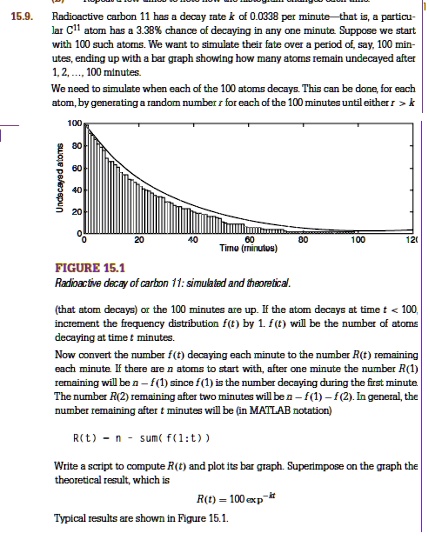
15.9. Radioactive carbon 11 has a decay rate k of 0.0338 per minute—that is, a particular C$^{11}$ atom has a 3.38% chance of decaying in any one minute. Suppose we start with 100 such atoms. We want to simulate their fate over a period of, say, 100 minutes, ending up with a bar graph showing how many atoms remain undecayed after 1, 2, ..., 100 minutes. We need to simulate when each of the 100 atoms decays. This can be done, for each atom, by generating a random number $r$ for each of the 100 minutes until either $r > k$ 100 80 Undecayed atoms 60 40 20 0 20 40 60 80 100 120 Time (minutes) FIGURE 15.1 Radioactive decay of carbon 11: simulated and theoretical. (that atom decays) or the 100 minutes are up. If the atom decays at time $t < 100$, increment the frequency distribution $f(t)$ by 1. $f(t)$ will be the number of atoms decaying at time $t$ minutes. Now convert the number $f(t)$ decaying each minute to the number $R(t)$ remaining each minute. If there are $n$ atoms to start with, after one minute the number $R(1)$ remaining will be $n - f(1)$ since $f(1)$ is the number decaying during the first minute. The number $R(2)$ remaining after two minutes will be $n - f(1) - f(2)$. In general, the number remaining after $t$ minutes will be (in MATLAB notation) $R(t) = n - \sum(f(1:t))$ Write a script to compute $R(t)$ and plot its bar graph. Superimpose on the graph the theoretical result, which is $R(t) = 100 \exp^{-kt}$ Typical results are shown in Figure 15.1.
View Answer
divider
BEST MATCH

Suppose the characteristic polynomial of a given closed-loop system is computed to be $s^4 + (11 + K_2)s^3 + (121 + K_1)s^2 + (K_1 + K_1K_2 + 110K_2 + 210)s + 11K_1 + 100 = 0$. Find constraints on the two gains $K_1$ and $K_2$ that guarantee a stable closed-loop system, and plot the allowable region(s) in the ($K_1, K_2$) plane. You may wish to use a computer to help solve this problem.

View Answer
divider
BEST MATCH

use the formula $A = \frac{1}{2}ab\sin C$ to find the area of the triangle with the given measurements. Round your answer to the nearest tenth $a = 25$, $b = 5$, $C = 70^{\circ}$ A -

View Answer
divider