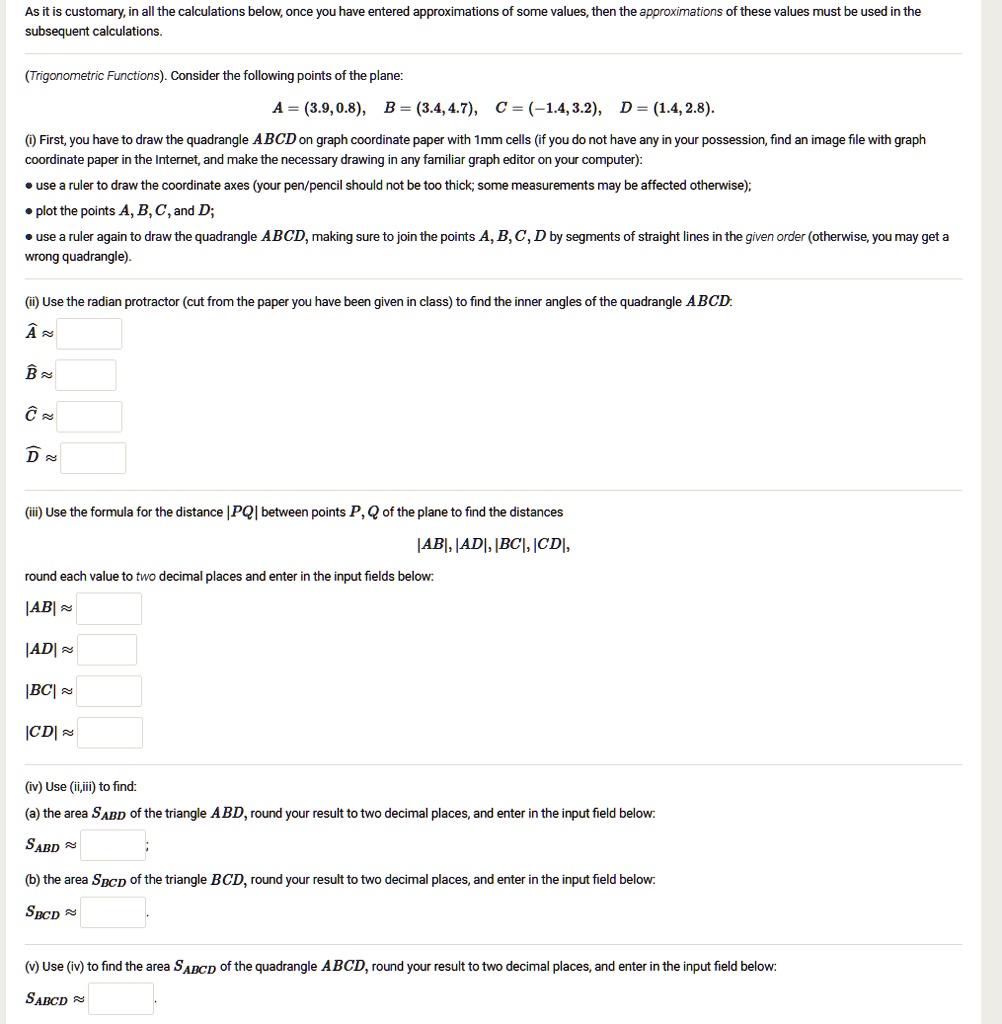
As it is customary, in all the calculations below, once you have entered approximations of some values, then the approximations of these values must be used in the
subsequent calculations.
(Trigonometric Functions). Consider the following points of the plane:
A = (3,9, 0.8), B = (3.4, 4.7), C = (-1.4, 3.2), D = (1.4, 2.8).
(i) First, you have to draw the quadrangle ABCD on graph coordinate paper with 1mm cells (if you do not have any in your possession, find an image file with graph
coordinate paper in the Internet, and make the necessary drawing in any familiar graph editor on your computer):
? use a ruler to draw the coordinate axes (your pen/pencil should not be too thick; some measurements may be affected otherwise);
• plot the points A, B, C, and D;
? use a ruler again to draw the quadrangle ABCD, making sure to join the points A, B, C, D by segments of straight lines in the given order (otherwise, you may get a
wrong quadrangle).
(ii) Use the radian protractor (cut from the paper you have been given in class) to find the inner angles of the quadrangle ABCD:
A \approx
B \approx
C \approx
D \approx
(iii) Use the formula for the distance $|PQ|$ between points $P$, $Q$ of the plane to find the distances
$|AB|$, $|AD|$, $|BC|$, $|CD|$,
round each value to two decimal places and enter in the input fields below:
$|AB| \approx$
$|AD| \approx$
$|BC| \approx$
$|CD| \approx$
(iv) Use (ii, iii) to find:
(a) the area $S_{ABD}$ of the triangle ABD, round your result to two decimal places, and enter in the input field below:
$S_{ABD} \approx$
(b) the area $S_{BCD}$ of the triangle BCD, round your result to two decimal places, and enter in the input field below:
$S_{BCD} \approx$
(v) Use (iv) to find the area $S_{ABCD}$ of the quadrangle ABCD, round your result to two decimal places, and enter in the input field below:
$S_{ABCD} \approx$