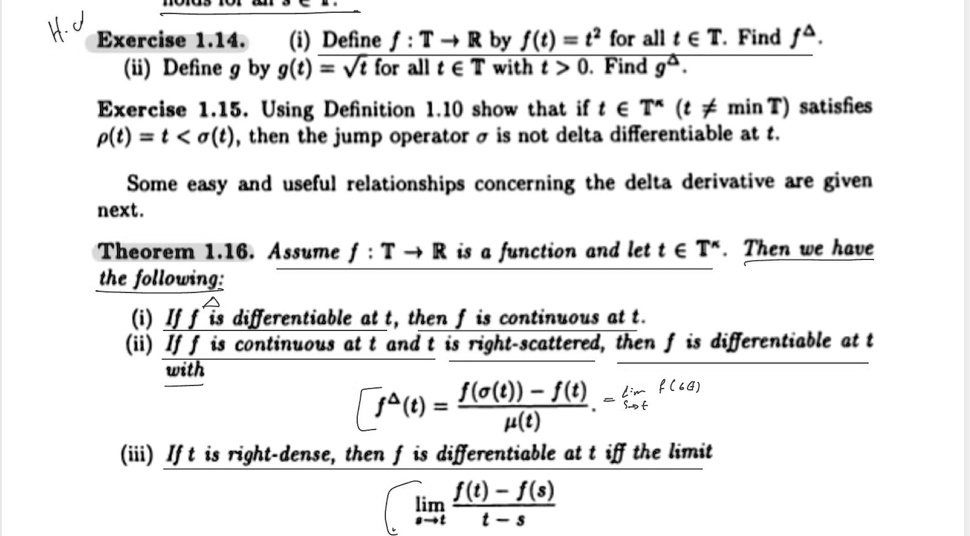
Exercise 1.14.
(i) Define f: T -> R by f(t) = t^2 for all t in T. Find f^Δ.
(ii) Define g by g(t) = √t for all t in T with t > 0. Find g^Δ.
Some easy and useful relationships concerning the delta derivative are given next.
Theorem 1.16. Assume f: T -> R is a function and let t in T. Then we have the following:
(i) If f is differentiable at t, then f is continuous at t.
(ii) If f is continuous at t and t is right-scattered, then f is differentiable at t with
(iii) If t is right-dense, then f is differentiable at t iff the limit lim(s->t) (f(t) - f(s))/(t - s).
Exercise 1.14. Define f: T -> R by f(t) = t for all t in T. Find f.
(ii) Define g by g(t) = √t for all t in T with t > 0. Find g.
Exercise 1.15. Using Definition 1.10 show that if t in T, t min T satisfies (t) = t < o(t), then the jump operator o is not delta differentiable at t.
Some easy and useful relationships concerning the delta derivative are given next.
Theorem 1.16. Assume f: T -> R is a function and let t in T. Then we have the following:
(i) If f is differentiable at t, then f is continuous at t.
(ii) If f is continuous at t and t is right-scattered, then f is differentiable at t with
(iii) If t is right-dense, then f is differentiable at t iff the limit lim t-s -> 0 (f(t) - f(s))/(t - s).