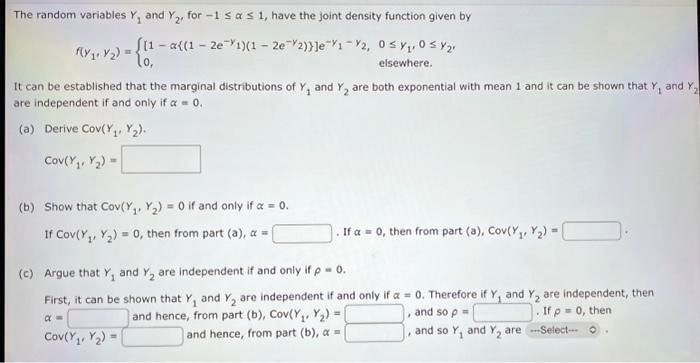
The random variables $Y_1$ and $Y_2$, for $-1 \le \alpha \le 1$, have the joint density function given by
$\begin{cases} \left[1 - \alpha \left( (1 - 2e^{-Y_1})(1 - 2e^{-Y_2}) \right) \right] e^{-Y_1 - Y_2}, & 0 \le Y_1, 0 \le Y_2 \\ 0, & \text{elsewhere} \end{cases}$
It can be established that the marginal distributions of $Y_1$ and $Y_2$ are both exponential with mean 1 and it can be shown that $Y_1$ and $Y_2$ are independent if and only if $\alpha = 0$.
(a) Derive $Cov(Y_1, Y_2)$.
$Cov(Y_1, Y_2) = $
(b) Show that $Cov(Y_1, Y_2) = 0$ if and only if $\alpha = 0$.
If $Cov(Y_1, Y_2) = 0$, then from part (a), $\alpha = $
If $\alpha = 0$, then from part (a), $Cov(Y_1, Y_2) = $
(c) Argue that $Y_1$ and $Y_2$ are independent if and only if $\rho = 0$.
First, it can be shown that $Y_1$ and $Y_2$ are independent if and only if $\alpha = 0$. Therefore if $Y_1$ and $Y_2$ are independent, then
$\alpha = $
and hence, from part (b), $Cov(Y_1, Y_2) = $
and hence, from part (b), $\alpha = $
and so $\rho = $
If $\rho = 0$, then
and so $Y_1$ and $Y_2$ are ----Select----