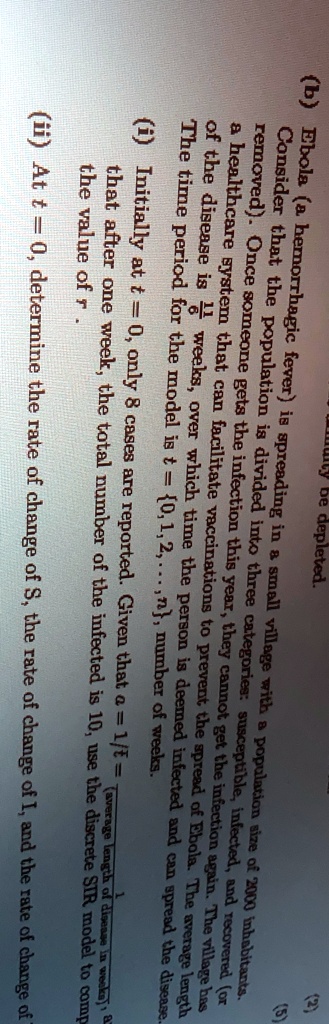
(b) Ebola (a hemorrhagic fever) is spreading in a small village with a population size of 2000 inhabitants. Consider that the population is divided into three categories: susceptible, infected, and recovered (or removed). Once someone gets the infection this year, they cannot get the infection again. The village has a healthcare system that can facilitate vaccinations to prevent the spread of Ebola. The average length of the disease is $\frac{11}{6}$ weeks, over which time the person is deemed infected and can spread the disease. The time period for the model is $t = \{0, 1, 2, ..., n\}$, number of weeks.
(i) Initially at $t = 0$, only 8 cases are reported. Given that $a = \frac{1}{t} = \text{(average length of disease in weeks)}$, that after one week, the total number of the infected is 10; use the discrete SIR model to compute the value of $r$.
(ii) At $t = 0$, determine the rate of change of $S$, the rate of change of $I$, and the rate of change of $R$.