Note: this exercise is in Spanish, when translating it it does not maintain the format, please read the exercise in English and take the values from the exercise in Spanish since it preserves the format.
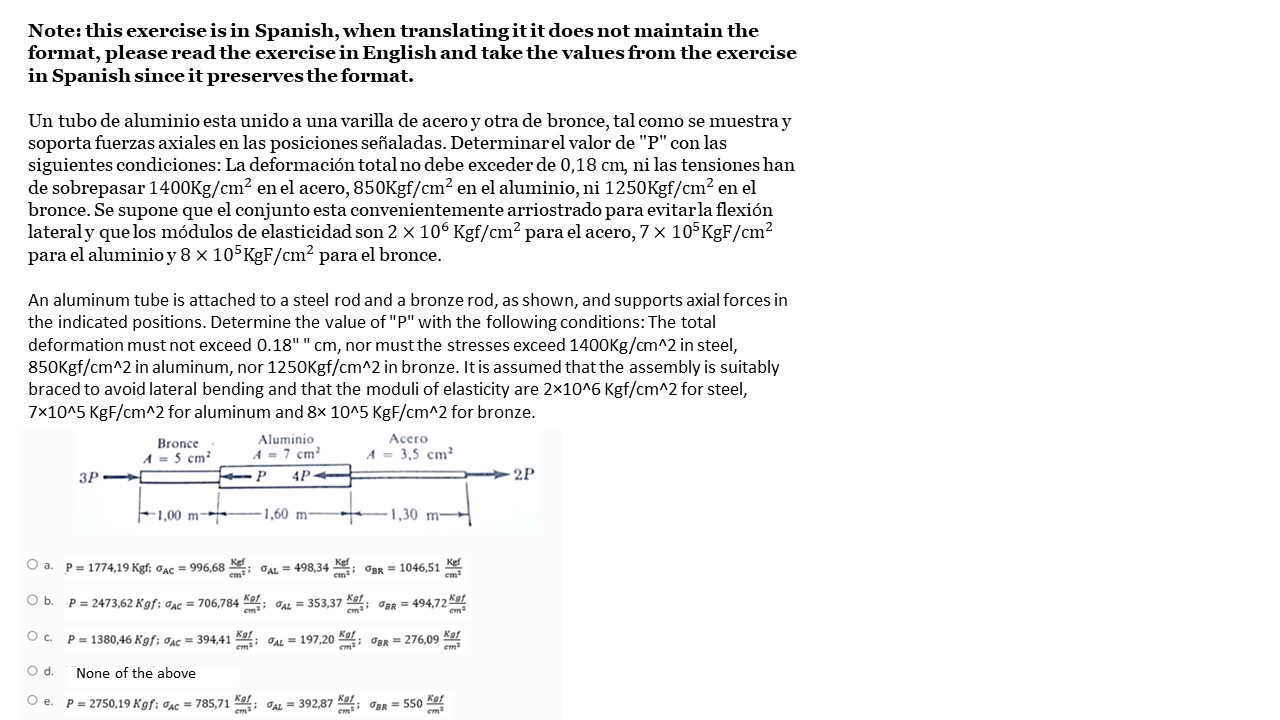
Un tubo de aluminio esta unido a una varilla de acero y otra de bronce, tal como se muestra y soporta fuerzas axiales en las posiciones señaladas. Determinar el valor de "P" con las siguientes condiciones: La deformación total no debe exceder de \( 0,18 \mathrm{~cm} \), ni las tensiones han de sobrepasar \( 1400 \mathrm{Kg} / \mathrm{cm}^{2} \) en el acero, \( 850 \mathrm{Kgf} / \mathrm{cm}^{2} \) en el aluminio, \( \mathrm{ni} 1250 \mathrm{Kgf} / \mathrm{cm}^{2} \) en el bronce. Se supone que el conjunto esta convenientemente arriostrado para evitarla flexión lateral y que los módulos de elasticidad son \( 2 \times 10^{6} \mathrm{Kgf} / \mathrm{cm}^{2} \) para el acero, \( 7 \times 10^{5} \mathrm{KgF} / \mathrm{cm}^{2} \) para el aluminio y \( 8 \times 10^{5} \mathrm{KgF} / \mathrm{cm}^{2} \) para el bronce.
An aluminum tube is attached to a steel rod and a bronze rod, as shown, and supports axial forces in the indicated positions. Determine the value of "P" with the following conditions: The total deformation must not exceed \( 0.18 " \mathrm{~cm} \), nor must the stresses exceed \( 1400 \mathrm{Kg} / \mathrm{cm}^{\wedge} 2 \) in steel, \( 850 \mathrm{Kgf} / \mathrm{cm}^{\wedge} 2 \) in aluminum, nor \( 1250 \mathrm{Kg} / \mathrm{cm}^{\wedge} 2 \) in bronze. It is assumed that the assembly is suitably braced to avoid lateral bending and that the moduli of elasticity are \( 2 \times 10^{\wedge} 6 \mathrm{Kgf} / \mathrm{cm}^{\wedge} 2 \) for steel, \( 7 \times 10^{\wedge} 5 \mathrm{KgF} / \mathrm{cm}^{\wedge} 2 \) for aluminum and \( 8 \times 10^{\wedge} 5 \mathrm{KgF} / \mathrm{cm}^{\wedge} 2 \) for bronze.
a. \( \mathrm{P}=1774,19 \mathrm{Kgf} ; \sigma_{\mathrm{AC}}=996,68 \frac{\mathrm{Kgf}}{\mathrm{cm}^{2}} ; \quad \sigma_{\mathrm{AL}}=498,34 \frac{\mathrm{Kgf}}{\mathrm{cm}^{2}} ; \sigma_{\mathrm{BR}}=1046,51 \frac{\mathrm{Kgf}}{\mathrm{cm}^{2}} \)
b. \( P=2473,62 \mathrm{Kgf} ; \sigma_{A C}=706,784 \frac{\mathrm{Kgf}}{\mathrm{cm}^{2}} ; \quad \sigma_{A L}=353,37 \frac{\mathrm{Kgf}}{\mathrm{cm}^{2}} ; \sigma_{B R}=494,72 \frac{\mathrm{Kgf}}{\mathrm{cm}^{2}} \)
c. \( P=1380,46 \mathrm{Kgf} ; \sigma_{A C}=394,41 \frac{\mathrm{Kgf}}{\mathrm{cm}^{2}} ; \quad \sigma_{A L}=197,20 \frac{\mathrm{Kgff}}{\mathrm{cm}^{2}} ; \quad \sigma_{B R}=276,09 \frac{\mathrm{Kgf}}{\mathrm{cm}^{2}} \)
d. None of the above
e. \( P=2750,19 K g f ; \sigma_{A C}=785,71 \frac{\mathrm{Kgf}}{\mathrm{cm}^{2}} ; \quad \sigma_{A L}=392,87 \frac{\mathrm{Kgf}^{2}}{\mathrm{~cm}^{2}} ; \quad \sigma_{B R}=550 \frac{\mathrm{Kgf}}{\mathrm{cm}^{2}} \)