Please help me with 1 through 9. Please do not answer my question if you can not do them. This is review for a test so please be clear in the steps shown and explain why you're doing the steps. There should be a graph. Thank you! I appreciate the help very much!
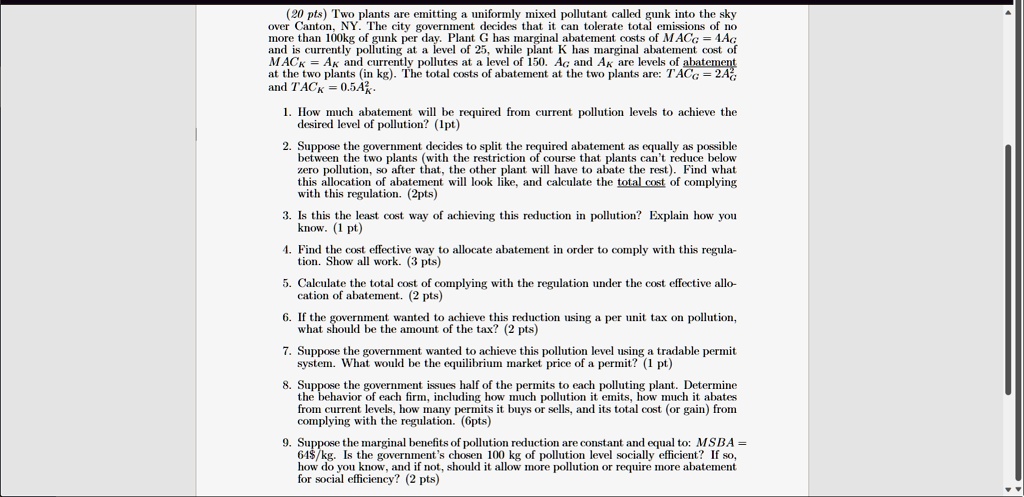
(20 pts) Two plants are emitting a uniformly mixed pollutant called gunk into the sky over Canton, NY. The city government decides that it can tolerate total emissions of no more than 100kg of gunk per day. Plant G has marginal abatement costs of MACc = 4Ac and is currently polluting at a level of 25, while plant K has marginal abatement cost of MAC = A and currently pollutes at a level of 150. Ac and A are levels of abatement at the two plants (in kg). The total costs of abatement at the two plants are: TACc = 2A2 and TAC = 0.5A?
1. How much abatement will be required from current pollution levels to achieve the desired level of pollution?(1pt)
2. Suppose the government decides to split the required abatement as equally as possible between the two plants (with the restriction of course that plants cant reduce below zero pollution, so after that, the other plant will have to abate the rest). Find what this allocation of abatement will look like, and calculate the total cost of complying with this regulation. (2pts) 3. Is this the least cost way of achieving this reduction in pollution? Explain how you know.1 pt
4. Find the cost effective way to allocate abatement in order to comply with this regula tion. Show all work. (3 pts) 5. Calculate the total cost of complying with the regulation under the cost effective allo- cation of abatement. (2 pts) 6. If the government wanted to achieve this reduction using a per unit tax on pollution, what should be the amount of the tax? (2 pts) 7. Suppose the government wanted to achieve this pollution level using a tradable permit system. What would be the equilibrium market price of a permit? (1 pt) 8. Suppose the government issues half of the permits to each polluting plant. Determine the behavior of each firm, including how much pollution it emits, how much it abates from current levels, how many permits it buys or sells, and its total cost (or gain) from complying with the regulation. (6pts) 9. Suppose the marginal benefits of pollution reduction are constant and equal to: MSBA = 64$/kg. Is the governments chosen 100 kg of pollution level socially efficient? If so, how do you know, and if not, should it allow more pollution or require more abatement for social efficiency? (2 pts)