Ace - AI Tutor
Ask Our Educators
Textbooks
My Library
Flashcards
Scribe - AI Notes
Notes & Exams
Download App
hailey donaldson

hailey d.

Divider

Questions asked

BEST MATCH

One card is drawn from a standard deck of 52 cards. Find the probabilityP(the card is a King)Here is a standard deck of 52 cards, the face cards are J, Q, and K.

View Answer
divider
BEST MATCH

Gerry's Generator Supply is approached by Mr. Gladstone, a new customer, to fulfill a large one-time-only special order for a product similar to one offered to regular customers. Gerry's Generator Supply has excess capacity. The following per unit data apply for sales to regular customers: Direct materials $850 Direct manufacturing labour 50 Variable manufacturing support 100 Fixed manufacturing support 75 Total manufacturing costs 1,075 Markup (20%) 215 Estimated selling price $1,290 If Mr. Gladstone wanted a long-term commitment for supplying this product, what price would most likely be quoted to him? Question 6 options: $1,290 $1,000 $1,200 $1,075 $1,400

View Answer
divider
BEST MATCH

After mutagenesis of wild type Vibrio fisheri, you isolate two different mutant strains (A and B) that, unlike the wild type cells, fail to luminesce when grown to high density in a flask with appropriate medium. Curiously, however, when you inoculate both mutant strains in the same flask, you observe that the mixed (A+B) culture begins to emit light after growing dense. a) What gene/functions are likely affected in each of the two mutants? b) How does this explain their phenotypes?

View Answer
divider
BEST MATCH

a) \( F=\left(x+y, y^{2}+z, z+x^{2}\right), \quad S\left(-m a^{2}+z=x^{2}+y^{2}+x+y, \quad x \in[0,1]\right. \)

View Answer
divider
BEST MATCH

\( \begin{array}{r}\frac{\sqrt{7}}{16 c^{2}} \\ \frac{48 \pm \sqrt{200^{2}}}{2}\end{array} \)

View Answer
divider
BEST MATCH

What is the unit of 19.665 found in question 1? $\frac{N}{m}$ $N$ $\frac{m}{N}$ $m$

View Answer
divider
BEST MATCH

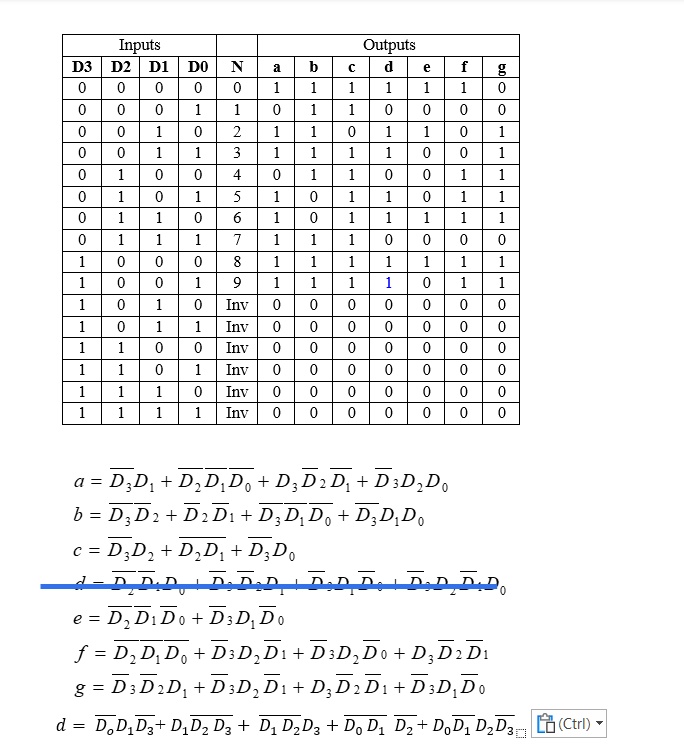
You are to design an 8421 BCD code converter to drive a 7-segment indicator. The four inputs to the converter network (A, B, C, D) represent an 8421 binary-coded decimal digit. Even though there are 16 combinations for a four-input network, assume that only input combinations representing 0 through 9 can occur as inputs, so the remaining six unused combinations don't care. Figure 5.1 shows a typical network driving a 7-segment display module. The details of a BCD decoder and a 7-segment are separately discussed as follows: 7-Segment Indicator Logic design often requires circuits to transmit data to human operators. A 7-segment indicator is frequently used to display any one of the decimal digits 0 through 9. A typical network driving 7-segment display module is shown in Figure 5.1. For example, one is indicated by lighting segments b and c (see Figure 5.2), and two by lighting segments a, b, g, e, and d. A segment is lighted when a logic 1 is applied to the corresponding input on the display module. Figure 5.2 shows the PIN for a SEC5010 7-segment display module to be used for your experiment. However, this experiment leaves pin 5, which is connected to the decimal point. Pins 3 and 8 are the connections for the ground. 7-Segment Display Circuit The network in Figure 5.1 is usually designed with the use of a BCD to 7-segment Decoder. A decoder generates all of the minterms of all the input variables. For instance, a 4-input decoder generates all of the 16 minterms of input variables. However, only combinations representing 0-9 are allowed for a BCD decoder. A 7-segment decoder is not available in the symbol library of Xilinx software, so we will design one. We will create the Decoder with active high outputs for a common cathode display. The lit display segments for each digit from 0 to 9 are given in the following truth table. 4.4 Procedure Part I: 7-segment Decoder Simulation Circuit Using Xilinx Please study the 7-segment Decoder before you do this section. 1. Set up the necessary truth table. 2. Implement the Decoder using Xilinx Schematic Capture. Using macros for the design is strongly encouraged. Figure 5.6 shows a typical design using macros. 3. Verify the operation and capture the appropriate graphs/diagrams to validate your design. Part II: 7-segment Decoder Circuit 1. Look up the 74LS48 BCD to 7-segment decoder/driver in your data book. Study and understand the functionality of this chip. 2. Draw and implement a circuit that uses a 74LS48 BCD to a 7-segment decoder to display the decimal equivalent of a 4-bit BCD number on a 7-segment display (SEC5010). Note that all unused pins of 74LS48 are connected to. 3. Use a DIP switch to input the values. Be sure to correctly hook up these switches. 4. Record output display for all input combinations using the DIP switch, including those invalid inputs. Inputs Outputs D3 D2 D0 N a b e f 0 0 0 0 1 1 1 1 1 0 0 0 0 1 1 1 0 0 0 0 0 0 0 2 0 0 0 0 3 0 0 . 4 0 1 1 0 0 1 0 1 0 0 0 0 0 0 J 8 1 0 9 1 1 0 0 1 0 Inv Inv 0 0 0 0 0 0 1 () 0 0 0 0 0 1 1 0 0 Inv Inv Inv Inv 0 0 0 0 1 1 0 ..: 0 0 0 0 0 0 0 0 0 1 1 0 0 0 0 1 1 1 1 0 0 0 0 0 0 a=DD+DDDo+DD2Di+D3DDo b=D;D2+D2D1+DD Do+DDDo c=DD+DD+DDo d-DDD e=DD1Do+D3D,Do f=DDDo+D3DD1+D3D,Do+D;D2Di g=D3D2D+D;D,D1+DD2Di+D;D Do d=DDDz+DDDz+DDDz+DoDDz+DDDD3mL(Ctr1)v
View Answer
divider
BEST MATCH

Is it socially responsible for Walmart to continue increasing prices and claiming bonuses during times of inflation? Why or why not?

View Answer
divider
BEST MATCH

You carry out Sanger sequencing, using 4 different reactions. Each reaction contains a small amount of a single ddNTP. You load the reaction products into a gel. (Letters above each lane indicate which ddNTP was included in the reaction loaded onto that lane of the gel.) You obtain the results shown at right. (Note: The wells into which DNA was loaded are at the top; the samples ran toward the bottom of the page.) What is the sequence of the strand synthesized during the sequencing reaction for patient 1? Please just write the sequence between the two arrows. Indicate 5' and 3' ends. (2 pts) Patient 1 Patient 2 ddA ddc ddG ddT ddA ddc ddG ddT Assuming the sequence that you wrote is the coding strand, indicate - on the gel, or on your sequence above - any potential start or stop codons that you find in the sequence for patient 1. (2 pts) You sequence the gene of a second individual, patient 2, and get the same result, except there is one mutation. If you select your first start codon above as the beginning of the gene, what type of mutation will this be and how might it affect the functionality of the protein? (2 pts)

View Answer
divider
BEST MATCH

Trial Analysis 1 Analysis 2 Analysis 3 Initial burette reading, mL 1.25 1.98 2.15 2.09 Final burette reading, mL 14.10 14.19 14.40 14.69 Volume of EDTA used / mL 12.85 12.21 12.25 12.60 moles of (Ca + Mg) [Ca + Mg] mol L?¹ aliquot Mean [Ca + Mg] mol L?¹ + stats Mass of EDTA used: 0.4698g Part A - Preparation of a 250 mL standard solution of ~0.005 M EDTA solution 1) Accurately weigh 0.46 g (~ 0.02 g) of the disodium salt and record the mass. 2) Transfer it quantitatively into a 250 ml volumetric flask. 3) Dissolve and make up to the mark with DEIONISED water. Part B - Determination of (Ca + Mg) by titration with EDTA 1) Pipette 100 ml of the tap water sample into a 250 ml conical flask. 2) Add about 3 ml of the pH 10 buffer solution. 3) Add a little (< 0.1 g) Eriochrome Black T indicator. The indicator tends to deepen during the titration so use the minimum amount needed to colour the solution and ensure that you add the same quantity of indicator for each titration. 4) Titrate with the EDTA solution until the wine-red colour is replaced by pure blue. 5) Repeat the titration at least twice more (RSD should be <2% Question 1. Calculate the concentration of your EDTA solution 2. Calculate the moles of (Ca + Mg) for Analysis 1, 2 and 3. 6

View Answer
divider