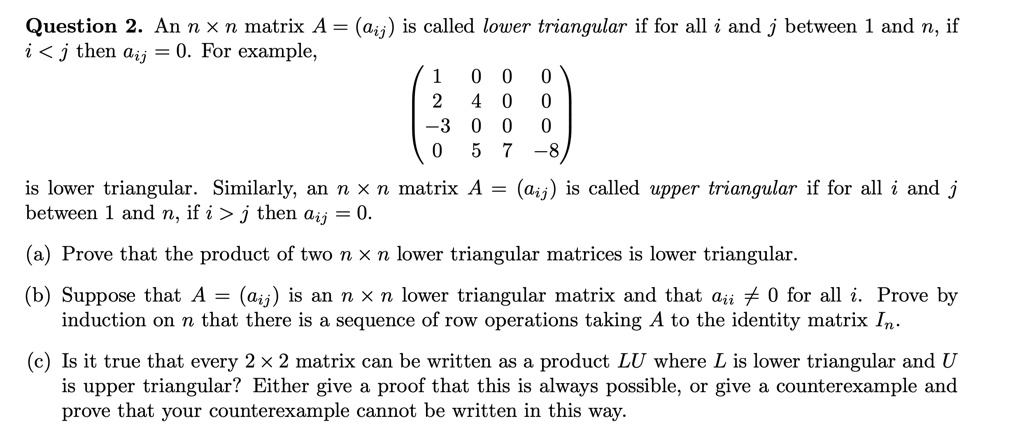
Question 2. An $n \times n$ matrix $A = (a_{ij})$ is called lower triangular if for all $i$ and $j$ between 1 and $n$, if $i < j$ then $a_{ij} = 0$. For example,
$\begin{pmatrix} 1 & 0 & 0 & 0 \\ 2 & 4 & 0 & 0 \\ -3 & 0 & 0 & 0 \\ 0 & 5 & 7 & -8 \end{pmatrix}$
is lower triangular. Similarly, an $n \times n$ matrix $A = (a_{ij})$ is called upper triangular if for all $i$ and $j$ between 1 and $n$, if $i > j$ then $a_{ij} = 0$.
(a) Prove that the product of two $n \times n$ lower triangular matrices is lower triangular.
(b) Suppose that $A = (a_{ij})$ is an $n \times n$ lower triangular matrix and that $a_{ii} \neq 0$ for all $i$. Prove by induction on $n$ that there is a sequence of row operations taking $A$ to the identity matrix $I_n$.
(c) Is it true that every $2 \times 2$ matrix can be written as a product $LU$ where $L$ is lower triangular and $U$ is upper triangular? Either give a proof that this is always possible, or give a counterexample and prove that your counterexample cannot be written in this way.