Ace - AI Tutor
Ask Our Educators
Textbooks
My Library
Flashcards
Scribe - AI Notes
Notes & Exams
Download App
Ibitola Torukuru

Ibitola T.

Divider

Viewed Questions

Find the indicated Trapezoid Rule approximations to the following integrals.
$$\int_{0}^{1} e^{-x} d x \text { using } n=8 \text { subintervals }$$

Find the indicated Trapezoid Rule approximations to the following integrals. $$\int_{0}^{1} e^{-x} d x \text { using } n=8 \text { subintervals }$$

Calculus for Scientists and Engineers: Early Transcendental

Integration Techniques

Numerical Integration

Find an equation of the tangent line to the graph of $f(x)=x e^{-x}$ at its inflection point.

Find an equation of the tangent line to the graph of $f(x)=x e^{-x}$ at its inflection point.

Applied Calculus for the Managerial, Life, and Social Sciences

Exponential and Logarithmic Function

Differentiation of Exponential Functions

Lambert's law of absorption states that the light intensity $I(x)$ (in calories per square centimeter per second) at a depth of $x$ m as measured from the surface of a material is given by $I=I_{0} a^{x},$ where $I_{0}$ and $a$ are positive constants. a. Find the rate of change of the light intensity with respect to $x$ at a depth of $x$ m from the surface of the material.
b. Using the result of part (a), conclude that the rate of change $I^{\prime}(x)$ at a depth of $x$ m is proportional to $I(x) .$ What is the constant of proportion?

Lambert's law of absorption states that the light intensity $I(x)$ (in calories per square centimeter per second) at a depth of $x$ m as measured from the surface of a material is given by $I=I_{0} a^{x},$ where $I_{0}$ and $a$ are positive constants. a. Find the rate of change of the light intensity with respect to $x$ at a depth of $x$ m from the surface of the material. b. Using the result of part (a), conclude that the rate of change $I^{\prime}(x)$ at a depth of $x$ m is proportional to $I(x) .$ What is the constant of proportion?

Applied Calculus for the MLSS A Brief Approach

Exponential and Logarithmic Functions

Differentiation of Logarithmic Functions

National health expenditures are projected to grow at the rate of
$$r(t)=0.0058 t+0.159 \quad(0 \leq t \leq 13)$$
trillion dollars/year from 2002 through 2015. Here, $t=0$ corresponds to 2002 . The expenditure in 2002 was $\1.60$ trillion.
a. Find a function $f$ giving the projected national health expenditures in year $f$
b. What does your model project the national health expenditure to be in $2015 ?$

National health expenditures are projected to grow at the rate of $$r(t)=0.0058 t+0.159 \quad(0 \leq t \leq 13)$$ trillion dollars/year from 2002 through 2015. Here, $t=0$ corresponds to 2002 . The expenditure in 2002 was $\1.60$ trillion. a. Find a function $f$ giving the projected national health expenditures in year $f$ b. What does your model project the national health expenditure to be in $2015 ?$

Applied Calculus for the MLSS A Brief Approach

Integration

Antiderivatives and the Rules of…

Questions asked

ANSWERED

Supreeta N verified

Numerade educator

1. Which one of the following compounds is covalent? Zn(CH3CO2)2 Al2O3 NH4F LiF HCl 2. Draw the Lewis structures for each of the following ions or molecules. Give the number of electrons in each species. Remember to enclose ions in square brackets with the charge as a superscript outside the right bracket. (a) COCl2 (C is the central atom) (b) POF3 (P is the central atom) (c) H2O (d) AsCl5 (e) IF4- 3. Lewis structures of two chemical species are shown below. For each, give (i) the formal charge on each atom and (ii) the overall charge on each species. Structure a Structure b Atom 1 H Na Atom 2 I Nb Atom 3 Oa Oa Atom 4 Ob Ob Atom 5 Oc Oc

View Answer
divider
ANSWERED

Supreeta N verified

Numerade educator

TABLE 9.1 Average Bond Energies Bond Bond Energy (kJ mol?¹) Bond Bond Energy (kJ mol?¹) Bond Bond Energy (kJ mol?¹) H—H 436 N—N 163 Br—F 237 H—C 414 N?N 418 Br—Cl 218 H—N 389 N?N 946 Br—Br 193 H—O 464 N—O 222 I—Cl 208 H—S 368 N?O 590 I—Br 175 H—F 565 N—F 272 I—I 151 H—Cl 431 N—Cl 200 Si—H 323 H—Br 364 N—Br 243 Si—Si 226 H—I 297 N—I 159 Si—C 301 C—C 347 O—O 142 Si—O 450 C?C 611 O?O 498 Si?Si 226 C?C 837 O—F 190 Si?O 523 C—N 305 O—Cl 203 Si—Cl 391 C?N 615 O—I 234 S—F 285 C?N 891 F—F 159 S—O 265 C—O 360 Cl—F 253 S?O 515 C?O 736* Cl—Cl 243 S—Cl 253 C?O 1072 S—Br 218 C—Cl 339 S—S 266 S?S 418 *799 in CO2

View Answer
divider
ANSWERED

Supreeta N verified

Numerade educator

3. (a) Which of the following atoms or ions is diamagnetic? Cu2+ Se4+ V2+ Co3+ V4+ (b) Which of the following atoms or ions is paramagnetic? Ga3+ Ni2+ Ge2+ Kr S4+ 4. Which one of the following elements has a +3 ion with 2 unpaired electrons? Ga Cu Mn B Ti 5. Use periodic trends and predict which of the following elements has the smallest first ionization energy. K Ca Si C 6. Use periodic trends and predict which of the following elements has the largest atomic radius. Ne Mg Ca S 7. Use periodic trends and predict which of the following ions has the largest radius. Al3+ O2- Mg2+ Na+ 8. Use the noble-gas notation and write the ground-state electronic configurations of the following ions: (a) Ba2+ (b) Ge4+ (c) V3+ 9. (a) Write the equation representing the 3rd ionization energy for Mn. (b) The electron affinity of Rb is 47 kJ/mol. Write the equation for which this is the energy change.

View Answer
divider
ANSWERED

Susan Hallstrom verified

Numerade educator

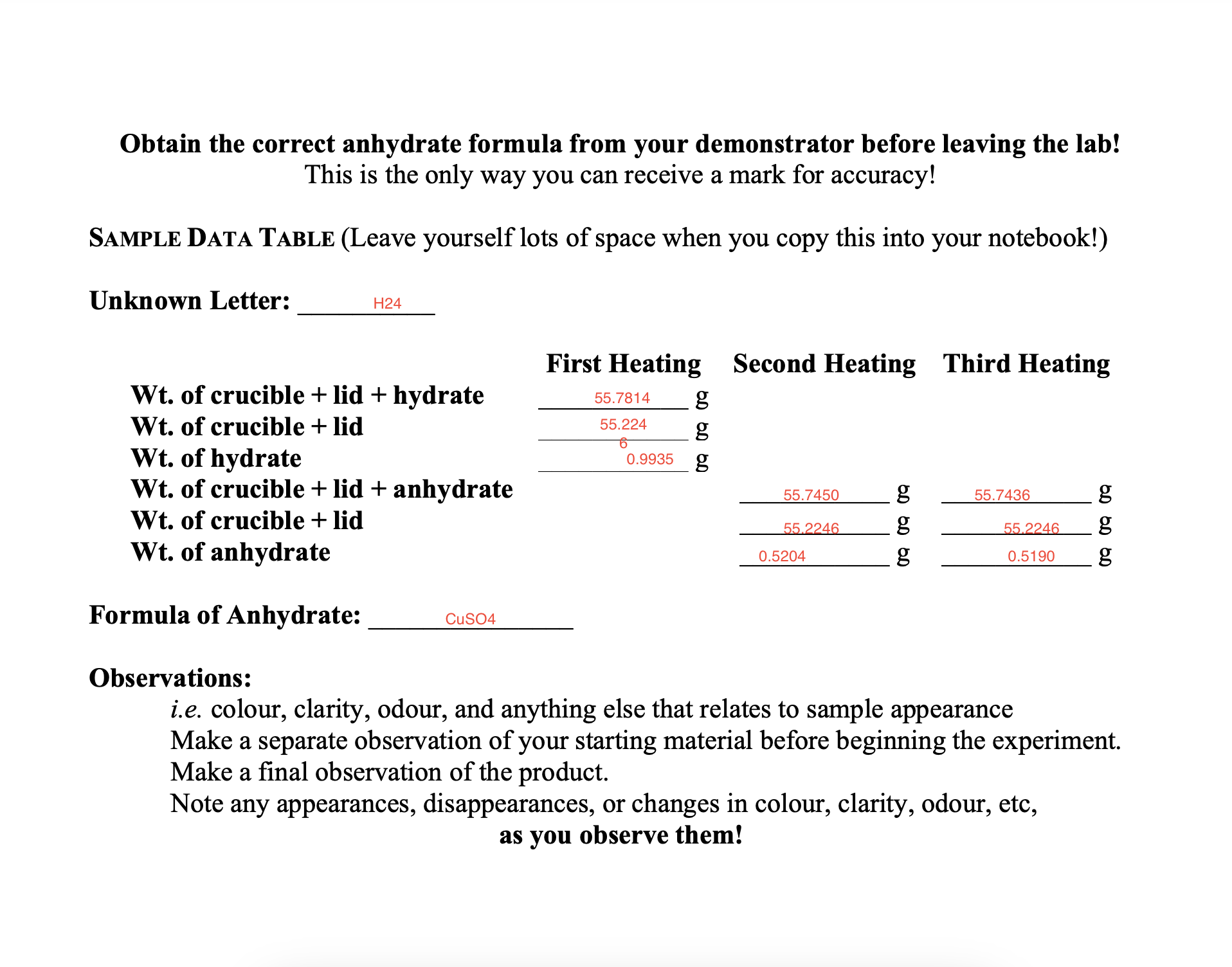
Obtain the correct anhydrate formula from your demonstrator before leaving the lab! This is the only way you can receive a mark for accuracy! SAMPLE DATA TABLE (Leave yourself lots of space when you copy this into your notebook!) Unknown Letter: H24 First Heating Second Heating Third Heating Wt. of crucible + lid + hydrate 55.7814 g Wt. of crucible + lid 55.2246 g Wt. of hydrate 0.9935 g Wt. of crucible + lid + anhydrate 55.7450 g 55.7436 g Wt. of crucible + lid 55.2246 g 55.2246 g Wt. of anhydrate 0.5204 g 0.5190 g Formula of Anhydrate: CuSO4 Observations: i.e. colour, clarity, odour, and anything else that relates to sample appearance Make a separate observation of your starting material before beginning the experiment. Make a final observation of the product. Note any appearances, disappearances, or changes in colour, clarity, odour, etc, as you observe them!
View Answer
divider