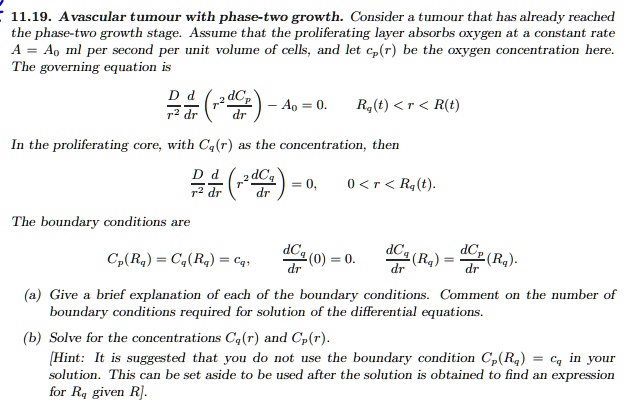
11.19. Avascular tumour with phase-two growth. Consider a tumour that has already reached the phase-two growth stage. Assume that the proliferating layer absorbs oxygen at a constant rate A = A$_0$ ml per second per unit volume of cells, and let $c_p(r)$ be the oxygen concentration here. The governing equation is
$\frac{D}{r^2}\frac{d}{dr}(r^2\frac{dc_p}{dr}) - A_0 = 0$.
$R_q(t) < r < R(t)$
In the proliferating core, with $c_q(r)$ as the concentration, then
$\frac{D}{r^2}\frac{d}{dr}(r^2\frac{dc_q}{dr}) = 0$,
$0 < r < R_q(t)$.
The boundary conditions are
$c_p(R_q) = c_q(R_q) = c_q$,
$\frac{dc_q}{dr}(0) = 0$.
$\frac{dc_q}{dr}(R_q) = \frac{dc_p}{dr}(R_q)$.
(a) Give a brief explanation of each of the boundary conditions. Comment on the number of boundary conditions required for solution of the differential equations.
(b) Solve for the concentrations $c_q(r)$ and $c_p(r)$.
[Hint: It is suggested that you do not use the boundary condition $c_p(R_q) = c_q$ in your solution. This can be set aside to be used after the solution is obtained to find an expression for $R_q$ given $R$].