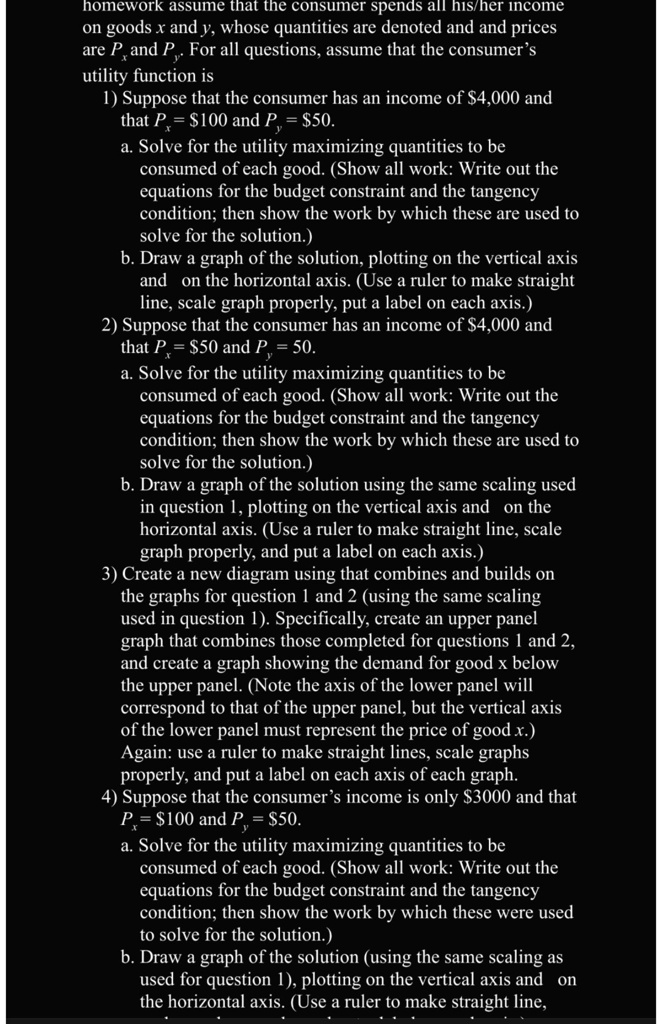
homework assume that the consumer spends all his/her income on goods x and y, whose quantities are denoted and and prices are P_(x) and P_(y). For all questions, assume that the consumer's utility function is
Suppose that the consumer has an income of $4,000 and that P_(x)=$100 and P_(y)=$50.
a. Solve for the utility maximizing quantities to be consumed of each good. (Show all work: Write out the equations for the budget constraint and the tangency condition; then show the work by which these are used to solve for the solution.)
b. Draw a graph of the solution, plotting on the vertical axis and on the horizontal axis. (Use a ruler to make straight line, scale graph properly, put a label on each axis.)
Suppose that the consumer has an income of $4,000 and that P_(x)=$50 and P_(y)=50.
a. Solve for the utility maximizing quantities to be consumed of each good. (Show all work: Write out the equations for the budget constraint and the tangency condition; then show the work by which these are used to solve for the solution.)
b. Draw a graph of the solution using the same scaling used in question 1, plotting on the vertical axis and on the horizontal axis. (Use a ruler to make straight line, scale graph properly, and put a label on each axis.)
Create a new diagram using that combines and builds on the graphs for question 1 and 2 (using the same scaling used in question 1). Specifically, create an upper panel graph that combines those completed for questions 1 and 2, and create a graph showing the demand for good x below the upper panel. (Note the axis of the lower panel will correspond to that of the upper panel, but the vertical axis of the lower panel must represent the price of good x.) Again: use a ruler to make straight lines, scale graphs properly, and put a label on each axis of each graph.
Suppose that the consumer's income is only $3000 and that P_(x)=$100 and P_(y)=$50.
a. Solve for the utility maximizing quantities to be consumed of each good. (Show all work: Write out the equations for the budget constraint and the tangency condition; then show the work by which these were used to solve for the solution.)
b. Draw a graph of the solution (using the same scaling as used for question 1), plotting on the vertical axis and on the horizontal axis. (Use a ruler to make straight line,
homework assume that the consumer spends all his/her income on goods x and y,whose quantities are denoted and and prices are P,and P,. For all questions, assume that the consumer's utility function is 1) Suppose that the consumer has an income of $4,000 and that P,=$100 and P,=$50.
a. Solve for the utility maximizing quantities to be consumed of each good.(Show all work: Write out the equations for the budget constraint and the tangency condition; then show the work by which these are used to solve for the solution.) b. Draw a graph of the solution, plotting on the vertical axis and on the horizontal axis.(Use a ruler to make straight line,scale graph properlv put a label on each axis.)
2 Suppose that the consumer has an income of $4,000 and that P,=$50 and P.=50 a. Solve for the utility maximizing quantities to be consumed of each good.Show all work:Write out the equations for the budget constraint and the tangency condition; then show the work by which these are used to solve for the solution.) b.Draw a graph of the solution using the same scaling used in question l,plotting on the vertical axis and on the horizontal axis.(Use a ruler to make straight line, scale graph properly,and put a label on each axis. 3 Create a new diagram using that combines and builds on the graphs for question l and 2 (using the same scaling used in question 1.Specifically, create an upper panel graph that combines those completed for questions l and 2 and create a graph showing the demand for good x below the upper panel.(Note the axis of the lower panel will correspond to that of the upper panel, but the vertical axis of the lower panel must represent the price of good x.) Again: use a ruler to make straight lines, scale graphs properly,and put a label on each axis of each graph 4 Suppose that the consumer's income is only $3000 and that P=$100 and P.=$50. a. Solve for the utility maximizing quantities to be consumed of each good.(Show all work: Write out the equations for the budget constraint and the tangency condition; then show the work by which these were used to solve for the solution.) b. Draw a graph of the solution (using the same scaling as used for question l,plotting on the vertical axis and on the horizontal axis.(Use a ruler to make straight line,