Questions asked
Which of these is an example of a non-cash expense that is adjusted for in the operating activities section of the cash flow statement? Group of answer choices Cost of Goods Sold Salary and wage expenses Rent expense Depreciation expense
Suppose a 250. mL flask is filled with 1.4 mol of $NO_3$ and 0.60 mol of $NO_2$. The following reaction becomes possible: $NO_3(g) + NO(g) \rightleftharpoons 2NO_2(g)$ The equilibrium constant $K$ for this reaction is 6.83 at the temperature of the flask. Calculate the equilibrium molarity of $NO_2$. Round your answer to two decimal places.
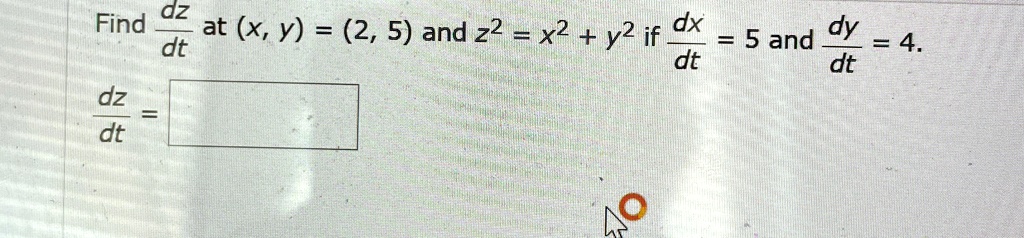
Find $\frac{dz}{dt}$ at $(x, y) = (2, 5)$ and $z^2 = x^2 + y^2$ if $\frac{dx}{dt} = 5$ and $\frac{dy}{dt} = 4$. $\frac{dz}{dt} =$
9. Assuming an ideal op-amp in the circuit below, determine the value of $R_x$ that will produce a voltage gain of 26
A negative externality indicates that the allocatively efficient quantity should be _____________ the free market level of production.
Find the indicated derivative and simplify. $f'(x)$ for $f(x) = \frac{27\sqrt[3]{x}}{x^2 - 1}$ f'(x) =
The compressor in a certain corner refrigerator performance 480 J of work to remove 150 J of heat from the interior of the refrigerator how much heat must cost behind the refrigerator discharge into the kitchen
A cart starts from position 4 with a velocity of 21.1 m/s to the left. Ignore friction. What is the speed with which the cart reaches position 3?
Describe the factors that lead to the perception of hunger or satiety.
Problem 2 [10 Marks] Assume that the input and output relation of the above RLC circuit can be represented as following complex domain representation: $E_o(s) = \frac{s+1}{s^2 + 4s + 4} E_i(s)$ 1) (6 marks) Calculate the system response $e_o(t)$ by using inverse Laplace transform when the system is subject to zero initial condition and a unit step input $e_i(t) = 1$ for $t>0$. Identify the transient and steady-state terms of the response in the system output response formulation you obtained; 2) (4 marks) Sketch the unit step response obtained from 1) and mark transient/dynamic and steady-state part of the system response respectively in the plot. 3) (3 marks) How about the system response $e_o(t)$ for a unit impulse input? (Optional: 3 bonus marks if you solve this sub-question).