Ace - AI Tutor
Ask Our Educators
Textbooks
My Library
Flashcards
Scribe - AI Notes
Notes & Exams
Download App
James Mcgill

James M.

Divider

Viewed Questions

(II) Determine the magnitudes and directions of the currents in each resistor shown in Fig. $52 .$ The batteries have emfs of $\mathscr{C}_{1}=9.0 \mathrm{V} \quad$ and $\quad 8_{2}=12.0 \mathrm{V}$ and the resistors have values of $R_{1}=25 \Omega, \quad R_{2}=48 \Omega, \quad$ and $R_{3}=35 \Omega.$ (a) Ignore internal resistance of the batteries. (b) Assume
each battery has internal resistance $r=1.0 \Omega .$

(II) Determine the magnitudes and directions of the currents in each resistor shown in Fig. $52 .$ The batteries have emfs of $\mathscr{C}_{1}=9.0 \mathrm{V} \quad$ and $\quad 8_{2}=12.0 \mathrm{V}$ and the resistors have values of $R_{1}=25 \Omega, \quad R_{2}=48 \Omega, \quad$ and $R_{3}=35 \Omega.$ (a) Ignore internal resistance of the batteries. (b) Assume each battery has internal resistance $r=1.0 \Omega .$

Physics for Scientists and Engineers with Modern Physics

(II) Determine the magnitudes and directions of the currents in each resistor shown in Fig. $19-48 .$ The batteries have emfs of $\mathscr{E}_{1}=9.0 \mathrm{V}$ and $\&_{2}=12.0 \mathrm{V}$ and the resistors have values of $R_{1}=25 \Omega, R_{2}=18 \Omega,$ and $R_{3}=35 \Omega$ .

(II) Determine the magnitudes and directions of the currents in each resistor shown in Fig. $19-48 .$ The batteries have emfs of $\mathscr{E}_{1}=9.0 \mathrm{V}$ and $\&_{2}=12.0 \mathrm{V}$ and the resistors have values of $R_{1}=25 \Omega, R_{2}=18 \Omega,$ and $R_{3}=35 \Omega$ .

Physics Principles with Applications

Questions asked

ANSWERED

Anand Jangid verified

Numerade educator

Consider the circuit shown in the figure. Take R1=2R , R2=R and R3=R , find the magnitude of the current passing through the resistor R2 in terms on V/R . Express your answer using one decimal place.

View Answer
divider
INSTANT ANSWER

Two conductor wires with currents \( I_{1}=2.4 \times 10^{5} \mathrm{~A} \) and \( I_{2}=6 \times 10^{5} \mathrm{~A} \) are located inside a uniform electric field \( \vec{E}=(-139 j) N / C \). The directions of the currents on the conductor wires are shown in the figure right. For the given instant, a charge particle \( (q=3.9 C) \) is passing at the center of the circle formed by the conductor wires with a velocity \( \vec{v}=(6.7 i-3 j) \mathrm{m} / \mathrm{s} \). What is the magnitude of the net force acting on the charged particle for that instant? (Take \( \mu_{0}=4 \pi 10^{-7} \mathrm{Tm} / A \), and \( R=17 \mathrm{~cm} \).) Provide your answer with zero decimal place.

View Answer
divider
INSTANT ANSWER

An initially uncharged parallel plate capacitor is connected to a circuit containing a battery with emf \( \varepsilon=43 \mathrm{~V} \) and a resistor, \( R \equiv 4 M \Omega \) as shown in the figure to below. The capacitor whose plates have an area of \( \bar{A}=7.4 \mathrm{~mm}^{2} \) are separated by a distance of \( \bar{d}=3.8 \mathrm{~mm} \) and one third of the capacitor is filled with a dielectric material, \( \kappa_{1}=1.1 \) and the rest (two thirds) is filled with another dielectric material, \( \kappa_{2}=3.6 \). At \( \mathrm{t}=0 \) the switch is closed. \( \overline{7.4} \) seconds after the switch is closed the electric field within the first dielectric material \( \left(\kappa_{1}\right) \) is observed to be \( 17 \times 10^{6} \mathrm{~N} / C \). Find the charge on the capacitor at this instant \( (t=7.4 \mathrm{~s}) \) in terms of permitivity of free space \( \epsilon_{0} \) ? Express your answer using zero decimal place.

View Answer
divider
ANSWERED

Ankur S verified

Numerade educator

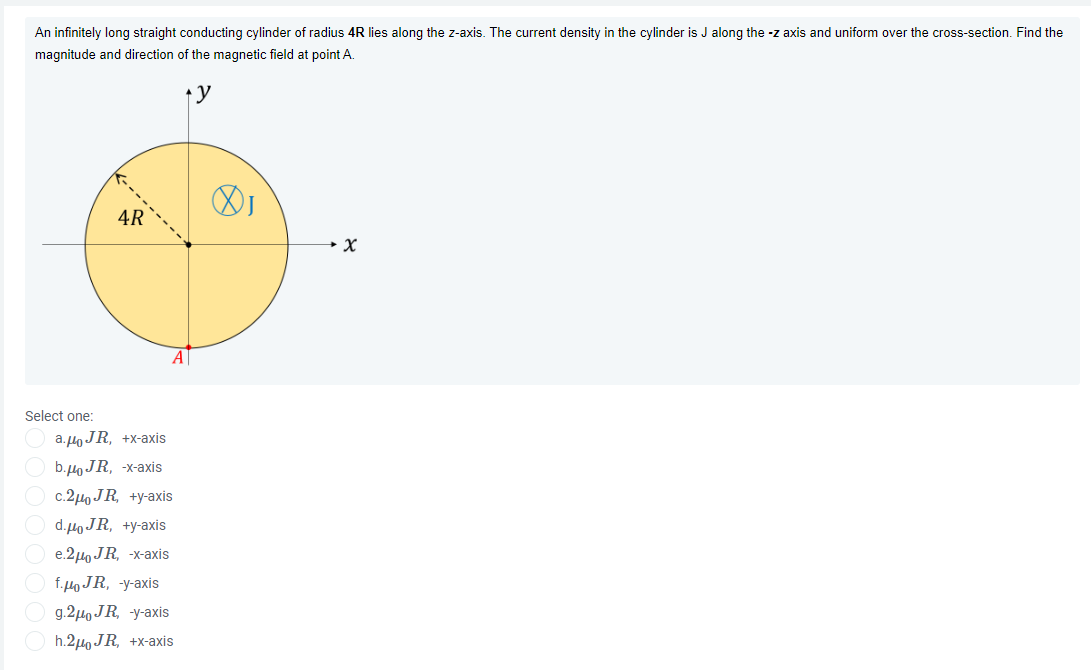
An infinitely long straight conducting cylinder of radius 4R lies along the z-axis. The current density in the cylinder is J along the -z axis and uniform over the cross-section. Find the magnitude and direction of the magnetic field at point A. Select one: a.??JR, +x-axis b.??JR, -x-axis c.2??JR, +y-axis d.??JR, +y-axis e.2??JR, -x-axis f.??JR, -y-axis g.2??JR, -y-axis h.2??JR, +x-axis
View Answer
divider
ANSWERED

Ankur S verified

Numerade educator

A cylindircal conducting wire carries a current of 1.32A . If the density of the conduction electrpns (free electrons) in the wire is n=6×1028 m−3 and the magnitude of the drift velocity of the electrons within the wire is v=6.9μm/s determine diameter the wire. Express your answer in units of mm using one decimal place. Take the charge of the electron qe=1.6×10⁻¹⁹C .

View Answer
divider