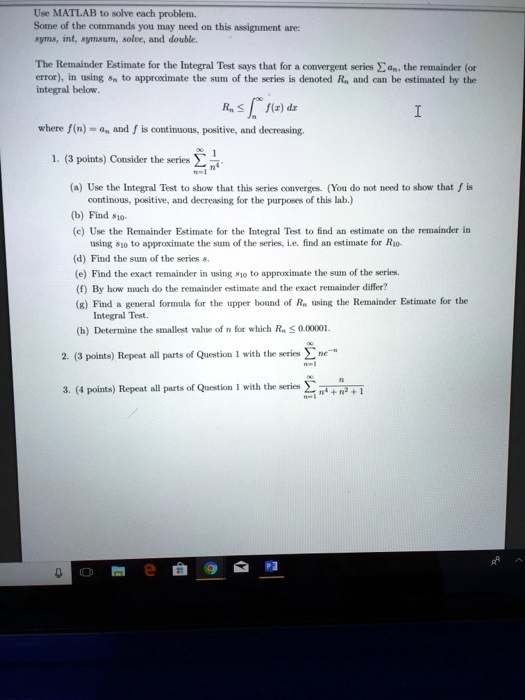
Use MATLAB to solve each problem.
Some of the commands you may need on this assignment are:
syms, int, symsum, solve, and double.
The Remainder Estimate for the Integral Test says that for a convergent series $\sum a_n$, the remainder (or
error), in using $s_n$ to approximate the sum of the series is denoted $R_n$ and can be estimated by the
integral below.
$R_n = \int_n^{\infty} f(x) dx$
where $f(n) = a_n$ and $f$ is continuous, positive, and decreasing.
1. (3 points) Consider the series $\sum_{n=1}^{\infty} \frac{1}{n^2}$
(a) Use the Integral Test to show that this series converges. (You do not need to show that $f$ is
continuous, positive, and decreasing for the purposes of this lab.)
(b) Find $s_{10}$.
(c) Use the Remainder Estimate for the Integral Test to find an estimate on the remainder in
using $s_{10}$ to approximate the sum of the series, i.e. find an estimate for $R_{10}$.
(d) Find the sum of the series $s$.
(e) Find the exact remainder in using $s_{10}$ to approximate the sum of the series.
(f) By how much do the remainder estimate and the exact remainder differ?
(g) Find a general formula for the upper bound of $R_n$ using the Remainder Estimate for the
Integral Test.
(h) Determine the smallest value of $n$ for which $R_n \le 0.00001$.
2. (3 points) Repeat all parts of Question 1 with the series $\sum_{n=1}^{\infty} \frac{n e^{-n}}{n}$
3. (4 points) Repeat all parts of Question 1 with the series $\sum_{n=1}^{\infty} \frac{n}{n^4 + n^2 + 1}$