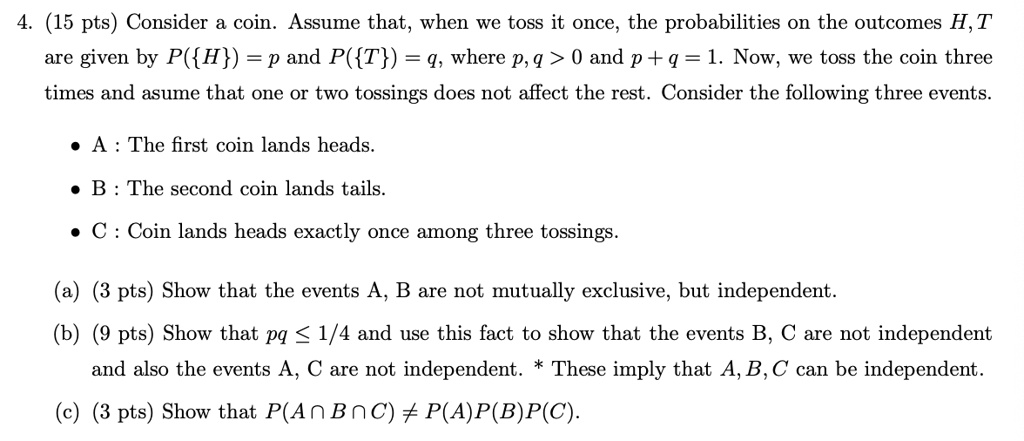
4. (15 pts) Consider a coin. Assume that, when we toss it once, the probabilities on the outcomes H, T
are given by $P({H}) = p$ and $P({T}) = q$, where $p, q > 0$ and $p + q = 1$. Now, we toss the coin three
times and asume that one or two tossings does not affect the rest. Consider the following three events.
• A: The first coin lands heads.
• B: The second coin lands tails.
• C: Coin lands heads exactly once among three tossings.
(a) (3 pts) Show that the events A, B are not mutually exclusive, but independent.
(b) (9 pts) Show that $pq ? 1/4$ and use this fact to show that the events B, C are not independent
and also the events A, C are not independent. * These imply that A, B, C can be independent.
(c) (3 pts) Show that $P(A?B?C) ? P(A)P(B)P(C)$.