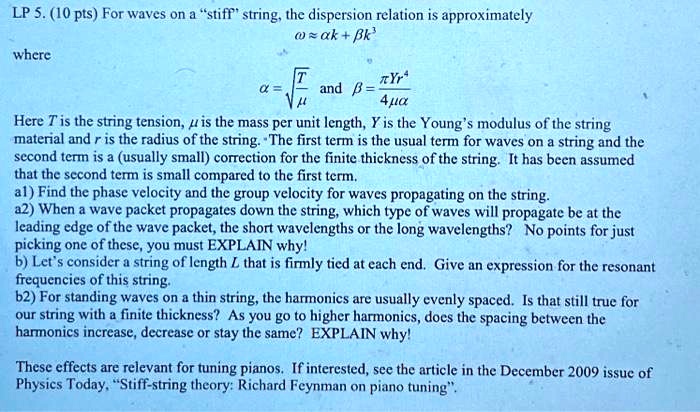
LP 5. (10 pts) For waves on a \"stiff\" string, the dispersion relation is approximately
$\omega \approx \alpha k + \beta k^3$
where
$\alpha = \sqrt{\frac{T}{\mu}}$ and $\beta = \frac{\pi Yr^4}{4\mu \alpha}$
Here T is the string tension, $\mu$ is the mass per unit length, Y is the Young's modulus of the string
material and r is the radius of the string. The first term is the usual term for waves on a string and the
second term is a (usually small) correction for the finite thickness of the string. It has been assumed
that the second term is small compared to the first term.
a1) Find the phase velocity and the group velocity for waves propagating on the string.
a2) When a wave packet propagates down the string, which type of waves will propagate be at the
leading edge of the wave packet, the short wavelengths or the long wavelengths? No points for just
picking one of these, you must EXPLAIN why!
b) Let's consider a string of length L that is firmly tied at each end. Give an expression for the resonant
frequencies of this string.
b2) For standing waves on a thin string, the harmonics are usually evenly spaced. Is that still true for
our string with a finite thickness? As you go to higher harmonics, does the spacing between the
harmonics increase, decrease or stay the same? EXPLAIN why!
These effects are relevant for tuning pianos. If interested, see the article in the December 2009 issue of
Physics Today, \"Stiff-string theory: Richard Feynman on piano tuning\".