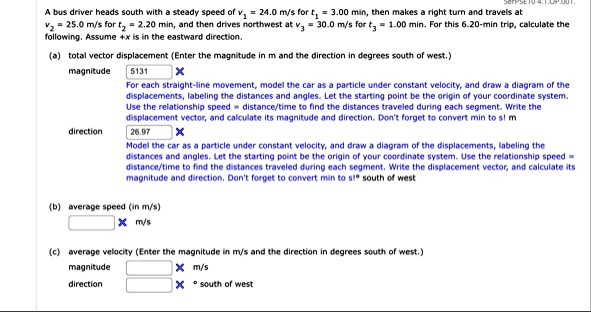
A bus driver heads south with a steady speed of $v_1 = 24.0 \text{ m/s}$ for $t_1 = 3.00 \text{ min}$, then makes a right turn and travels at $v_2 = 25.0 \text{ m/s}$ for $t_2 = 2.20 \text{ min}$, and then drives northwest at $v_3 = 30.0 \text{ m/s}$ for $t_3 = 1.00 \text{ min}$. For this $6.20 \text{-min}$ trip, calculate the following. Assume $+x$ is in the eastward direction.
(a) total vector displacement (Enter the magnitude in m and the direction in degrees south of west.)
magnitude 5131 X
For each straight-line movement, model the car as a particle under constant velocity, and draw a diagram of the displacements, labeling the distances and angles. Let the starting point be the origin of your coordinate system. Use the relationship speed = distance/time to find the distances traveled during each segment. Write the displacement vector, and calculate its magnitude and direction. Don't forget to convert min to s! m
direction 26.97 X
Model the car as a particle under constant velocity, and draw a diagram of the displacements, labeling the distances and angles. Let the starting point be the origin of your coordinate system. Use the relationship speed = distance/time to find the distances traveled during each segment. Write the displacement vector, and calculate its magnitude and direction. Don't forget to convert min to s!° south of west
(b) average speed (in m/s)
X m/s
(c) average velocity (Enter the magnitude in m/s and the direction in degrees south of west.)
magnitude X m/s
direction X ° south of west