Question 3:
(30 points)
The product D is to be produced through the reaction of A with B in an isothermal
semibatch reactor initially filled with one of the reactants while the other is continuously
fed to the reactor. The following reactions take place:
A+2B$\rightarrow$C+D $r_{D1} = k_{D1}C_AC_B^2$
2D+3A$\rightarrow$C+E $r_{E2} = k_{E2}C_AC_D$
B+2C$\rightarrow$D+F $r_{F3} = k_{F3}C_BC_C^2$
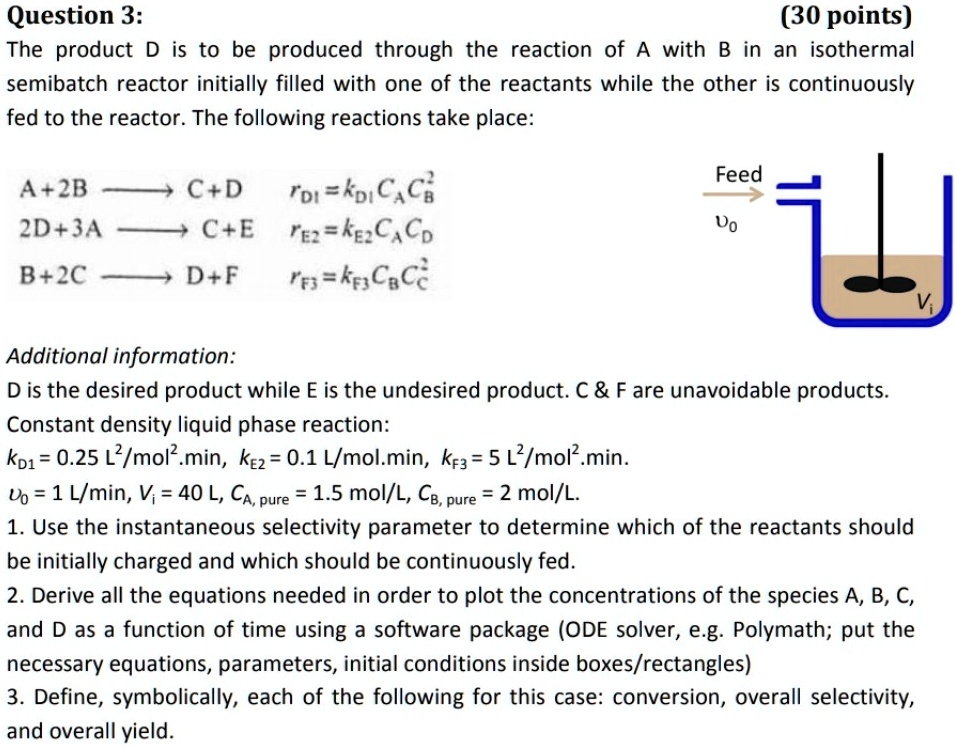
Feed
$v_0$
Additional information:
D is the desired product while E is the undesired product. C & F are unavoidable products.
Constant density liquid phase reaction:
k_{D1} = 0.25 L$^2$/mol$^2$.min, k_{E2} = 0.1 L/mol.min, k_{F3} = 5 L$^2$/mol$^2$.min.
v$_0$ = 1 L/min, V$_i$ = 40 L, C$_{A, pure}$ = 1.5 mol/L, C$_{B, pure}$ = 2 mol/L.
1. Use the instantaneous selectivity parameter to determine which of the reactants should
be initially charged and which should be continuously fed.
2. Derive all the equations needed in order to plot the concentrations of the species A, B, C,
and D as a function of time using a software package (ODE solver, e.g. Polymath; put the
necessary equations, parameters, initial conditions inside boxes/rectangles)
3. Define, symbolically, each of the following for this case: conversion, overall selectivity,
and overall yield.