Ace - AI Tutor
Ask Our Educators
Textbooks
My Library
Flashcards
Scribe - AI Notes
Notes & Exams
Download App
jennifer brooks

jennifer b.

Divider

Questions asked

BEST MATCH

A population has a mean $\mu = 76$ and a standard deviation $\sigma = 6$. Find the mean and standard deviation of a sampling distribution of sample means with sample size $n = 36$. $\mu_{\bar{x}} = \Box$ (Simplify your answer.)

View Answer
divider
BEST MATCH

When driving a large U-Haul truck, to avoid a side-to-side collision it is best to do which of the following? Avoid driving during rainy days Avoid driving next to other trucks Avoid strong braking Avoid driving at low speeds

View Answer
divider
BEST MATCH

According to the Solow growth theory, developing nations will catch up to the developed nations if developing nations become more politically stable. if developing nations invest in more education for their workers. because developing nations can borrow technologies from the developed nations and learn from their mistakes. at no foreseeable time in the future.

View Answer
divider
BEST MATCH

The Bhagavad Gita is a "Dharmic" text. God knows the path. As humans we can't see the whole picture, so dharma dictates that we follow the path god has laid before us and trust in the divine plan. What do you think of that idea? Let's discuss.

View Answer
divider
BEST MATCH

Evaluate the definite integral. Use anti-derivatives and the Fundamental Theorem of Calculus.\\ \(12) \int_{-4}^{6} e^x dx\)

View Answer
divider
BEST MATCH

Consider the exponential function f(x) = e^(-x-1). Find the inverse function of f(x) and the domian of f^(-1)(x).

View Answer
divider
BEST MATCH

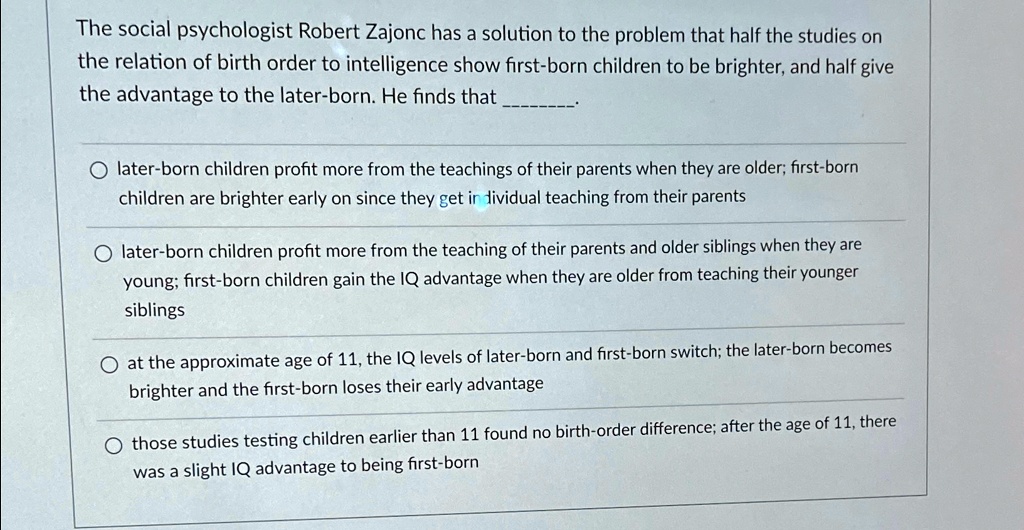
The social psychologist Robert Zajonc has a solution to the problem that half the studies on the relation of birth order to intelligence show first-born children to be brighter, and half give the advantage to the later-born. He finds that \text{later-born children profit more from the teachings of their parents when they are older; first-born} \text{children are brighter early on since they get individual teaching from their parents} \text{later-born children profit more from the teaching of their parents and older siblings when they are} \text{young; first-born children gain the IQ advantage when they are older from teaching their younger} \text{siblings} \text{at the approximate age of 11, the IQ levels of later-born and first-born switch; the later-born becomes} \text{brighter and the first-born loses their early advantage} \text{those studies testing children earlier than 11 found no birth-order difference; after the age of 11, there} \text{was a slight IQ advantage to being first-born}
View Answer
divider
BEST MATCH

5. Find the amplitude, period, frequency and angular velocity of the MAS. Fig. 1 Fig. 1 x(cm) 3.0 2.0 1.0 -1.0 -2.0 -3.0 0.50 1.0 $v_x$(cm/s) 20 10 -10 -20 0.2 0.6 1.0 1.4 1.6 $t$(s) Find the maximum speed, angular velocity and amplitude. fig. 2.

View Answer
divider
BEST MATCH

Research in which existing data such as census documents, college records, and newspaper clippings, are examined to test a hypothesis is known as: Select one: a. Experimental Research b. A Case Study c. Naturalistic Research d. Archival Research

View Answer
divider
BEST MATCH

Find the slope of the tangent line to the curve (a lemniscate) $2(x^2 + y^2)^2 = 25(x^2 - y^2)$ at the point $(-3, -1)$ slope = -0.69230769230769

View Answer
divider