Ex(P) = 1.15 x 10^8 N/N
Ey(P) = 0 N/C
phi = 4.63 x 10^6 N•m^2/C
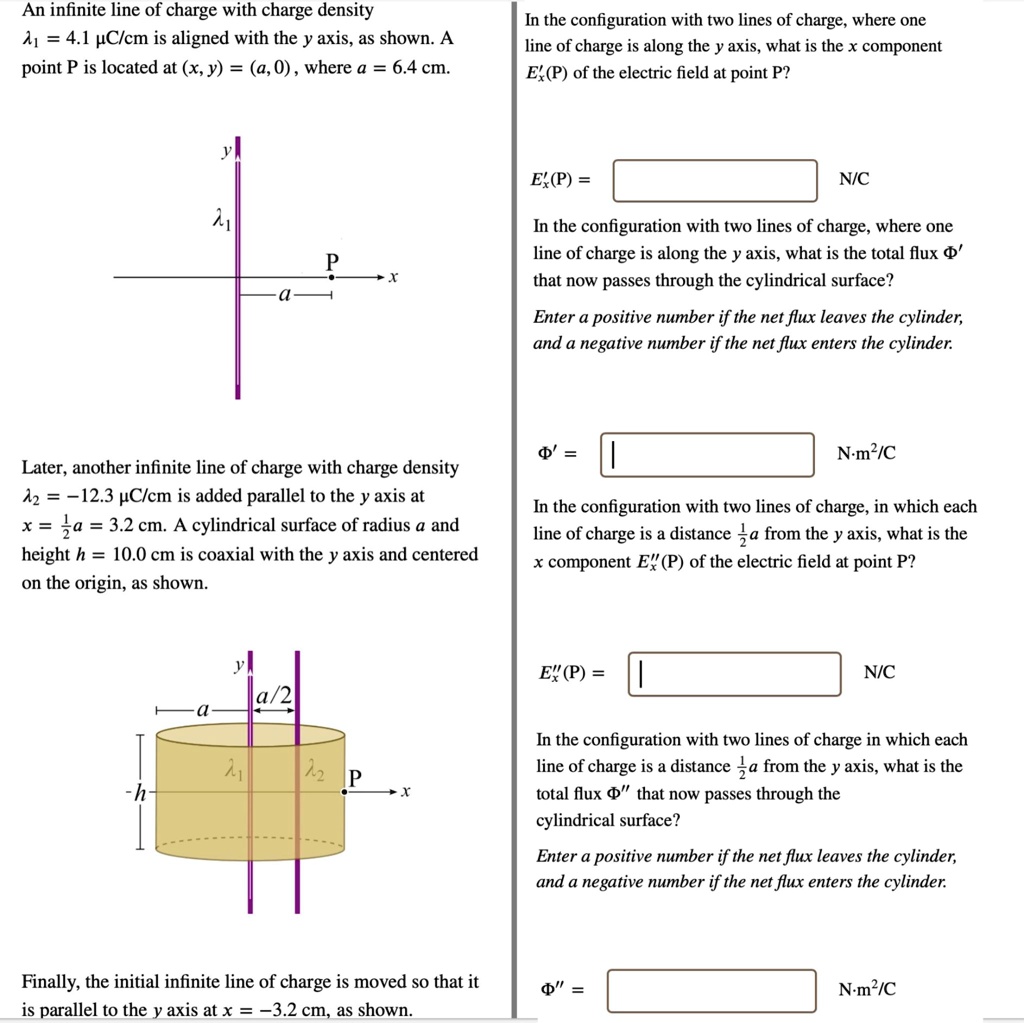
An infinite line of charge with charge density
In the configuration with two lines of charge, where one line of charge is along the y axis, what is the x component E(P) of the electric field at point P?
= 4.1 C/cm is aligned with the y axis, as shown.A
point P is located atx,y=a,0,where a=6.4 cm.
yl
E(P) =
N/C
In the configuration with two lines of charge, where one line of charge is along the y axis, what is the total flux ' that now passes through the cylindrical surface?
P
n
Enter a positive number if the net flux leaves the cylinder and a negative number if the net flux enters the cylinder.
=
N-m2/C
Later, another infinite line of charge with charge density
2 = -12.3 C/cm is added parallel to the y axis at
In the configuration with two lines of charge, in which each line of charge is a distance a from the y axis, what is the x component E(P) of the electric field at point P?
x = a = 3.2 cm. A cylindrical surface of radius a and height h = 10.0 cm is coaxial with the y axis and centered
on the origin,as shown
E(P)=
N/C
a/2
a
In the configuration with two lines of charge in which each line of charge is a distance from the y axis, what is the total flux " that now passes through the cylindrical surface?
P
Enter a positive number if the net flux leaves the cylinder,
and a negative number if the net flux enters the cylinder
Finally, the initial infinite line of charge is moved so that it
N-m2/C
is parallel to the y axis at x = -3.2 cm, as shown.