The balance sheet of a company shows a firm’s assets and liabilities (and stockholders’ equity). In other words, at any given point in time, the balance sheet illustrates a firm’s overall financial position. A typical balance sheet shows assets owned by the company on the left, along with the firm’s liabilities and equity on the right.
The assets are usually organized into two major types: current assets and fixed (or long-term) assets. Current assets include cash, cash equivalents, accounts receivable, and inventory. These are assets that are expected to be converted to cash in short order. Fixed assets include net plant, property, and equipment, along with other long-term assets.
Similarly, the right side of the balance sheet is usually organized into two major categories: liabilities (money owed by the company) and stockholders’ equity. Current liabilities are claims that are due within one year. These types of liabilities typically consist of things like accounts payable, accruals, notes payable to banks. Long-term debt can include bonds with maturity dates far into the future. Stockholders’ equity can be written as either the sum of paid-in capital and retained earnings, or the difference between total assets and total liabilities.
The various financial ratios commonly used to analyze the financial strength of a company can also be used to relate the various entries on the balance sheet together. For example, the current ratio is calculated by dividing current assets by current liabilities. Thus, in theory, if you knew the current ratio and the value of current liabilities, you could solve for the value of current assets by multiplying the current asset ratio by current liabilities.
Additionally financial ratios can also be used to relate items from the balance sheet to items in the income statement, such as sales or cost of goods sold. For example, the total assets turnover ratio can be calculated as sales (from the income statement) divided by total assets (from the balance sheet). In theory, if you know the total assets turnover ratio as well as the value of total assets, you can solve for sales by multiplying the total assets turnover ratio by total assets.
True or False: Liabilities generally appear on the left side of the balance sheet.
True
False
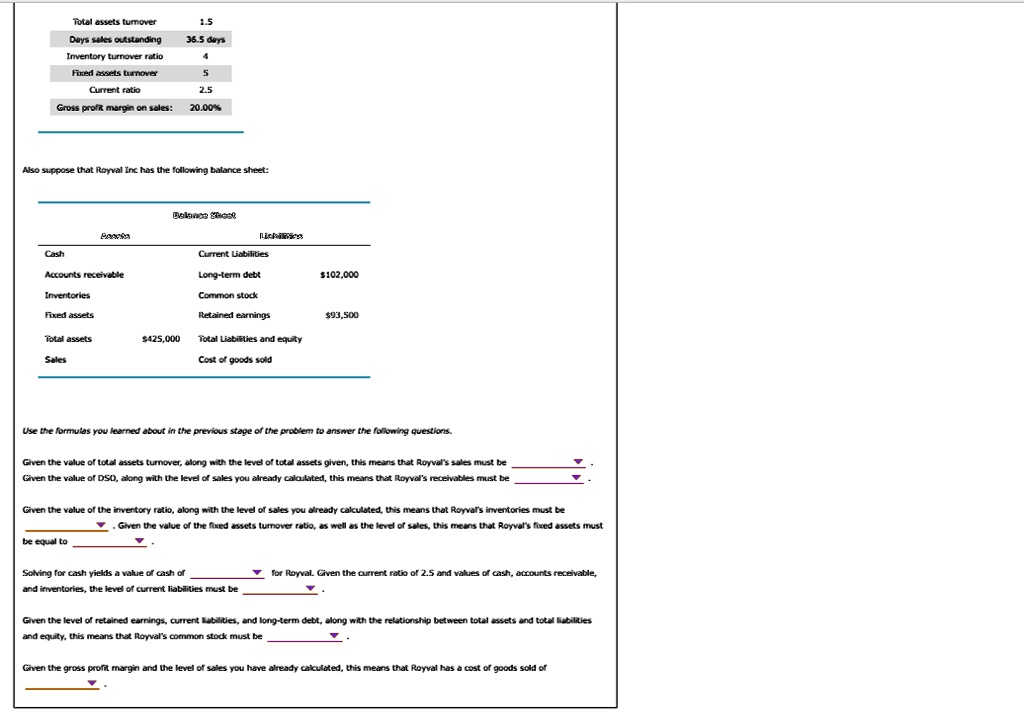
Plant equipment (net) would generally appear under fixed assets on the balance sheet. Also suppose that Royval Inc has the following balance sheet:
Balance Sheet
Assets
Liabilities
Use the formulas you learned about in the previous stage of the problem to answer the following questions.
Given the value of total assets turnover, along with the level of total assets given, this means that Royval's sales must be
Given the value of DSO, along with the level of sales you already calculated, this means that Royval's receivables must be
Given the value of the inventory ratio, along with the level of sales you already calculated, this means that Royval's inventories must be
z. Given the value of the fixed assets turnover ratio, as well as the level of sales, this means that Royval's fixed assets must.
be equal to
-.
Solving for cash yields a value of cash of
for Royval. Given the current ratio of 2.5 and values of cash, accounts receivable,
and inventories, the level of current liabilities must be
Given the level of retained earnings, current liabilities, and long-term debt, along with the relationship between total assets and total liabilities
and equity, this means that Royval's common stock must be
Given the gross profit margin and the level of sales you have already calculated, this means that Royval has a cost of goods sold of
Total assets turnover
1.5 36.5 deys 4 5
Inventory turnover ratio Fixed assets trarnover Current ratio Gross profk margin on sales:
2.5 20.00%
Also suppose that Royval Inc has the following balance sheet:
Balance Sheet
Assets
Liabilities
Current Liabilities
Cash
Accounts receivable
Long-term debt
$102,000
Inventories
Common stock
Fixed assets
Retained earnings
$93,500
Total assets Sales
$425,000
Total Liabilities and equity Cost of goods sold
Use the form
the foliowng guestiors
ssets turnover, along with the level of to
sets given,this r
Given the value of the
ntory ratio, along with the level of sales you already calculated, this means that Royval's inventories must be
.Ghven the value of the foed assets turmover ratio. es well es the level of sales.this means that Royval's feed essets mus
be equal to
4
Solving for cash yields a vakue of cash of and imventories, the level of current liabilities nust be
for Royval. Given the current ratio of 2.5
Given the level of retained earnings, current Eabilities,and long-term debt,along with the relati
and equity, this means that Royval's common stock must be
Given the gross profit margin and the level of sales you have already cakulated, this means that Royval has a cost of goods sold ot