Part 2: Oligopoly and Strategic Interaction
Oligopoly is similar to monopoly in that output is lower, and prices are higher, than would be the case under perfect competition. In oligopoly, the market is dominated by only a few sellers, at least some of which control enough the market to enable them to influence price. Like in monopoly, there will be some barriers to entry. Unlike monopoly, however, firms must consider what their rival firms will do. In fact, because there are only a few sellers, each firm has a big impact on the market. In an oligopoly, each frim must consider the reactions of its rival firms when deciding on their own behavior.
The equilibrium quantity of output in an oligopoly will be higher than in a monopoly, but lower than in perfect competition. The equilibrium price will be less than the monopoly, but higher than the price under perfect competition.
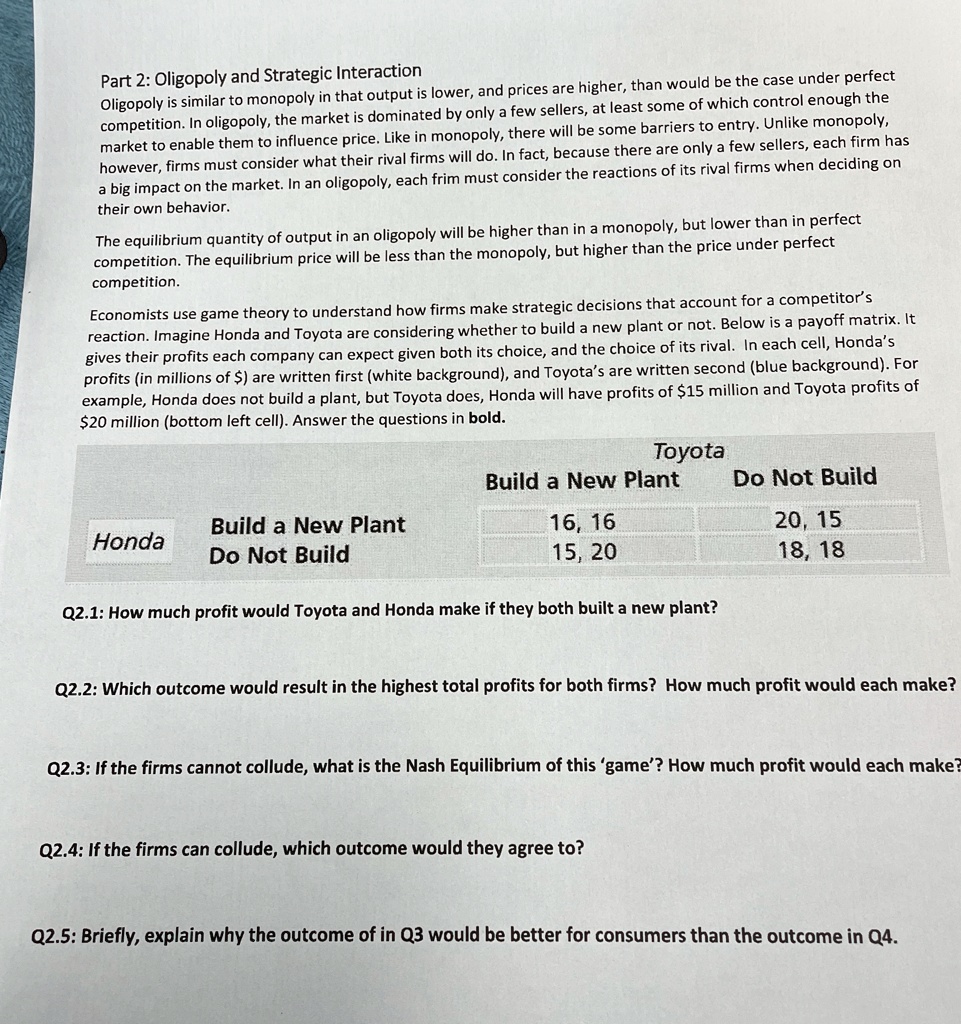
Economists use game theory to understand how firms make strategic decisions that account for a competitor's reaction. Imagine Honda and Toyota are considering whether to build a new plant or not. Below is a payoff matrix. It gives their profits each company can expect given both its choice, and the choice of its rival. In each cell, Honda's profits (in millions of $) are written first (white background), and Toyota's are written second (blue background). For example, Honda does not build a plant, but Toyota does, Honda will have profits of $15 million and Toyota profits of $20 million (bottom left cell). Answer the questions in bold.
Toyota
Build a New Plant Do Not Build
Honda Build a New Plant 16, 16 20, 15
Do Not Build 15, 20 18, 18
Q2.1: How much profit would Toyota and Honda make if they both built a new plant?
Q2.2: Which outcome would result in the highest total profits for both firms? How much profit would each make?
Q2.3: If the firms cannot collude, what is the Nash Equilibrium of this 'game'? How much profit would each make?
Q2.4: If the firms can collude, which outcome would they agree to?
Q2.5: Briefly, explain why the outcome of in Q3 would be better for consumers than the outcome in Q4.