1 Mixed boundary conditions for 2d Laplace's equation
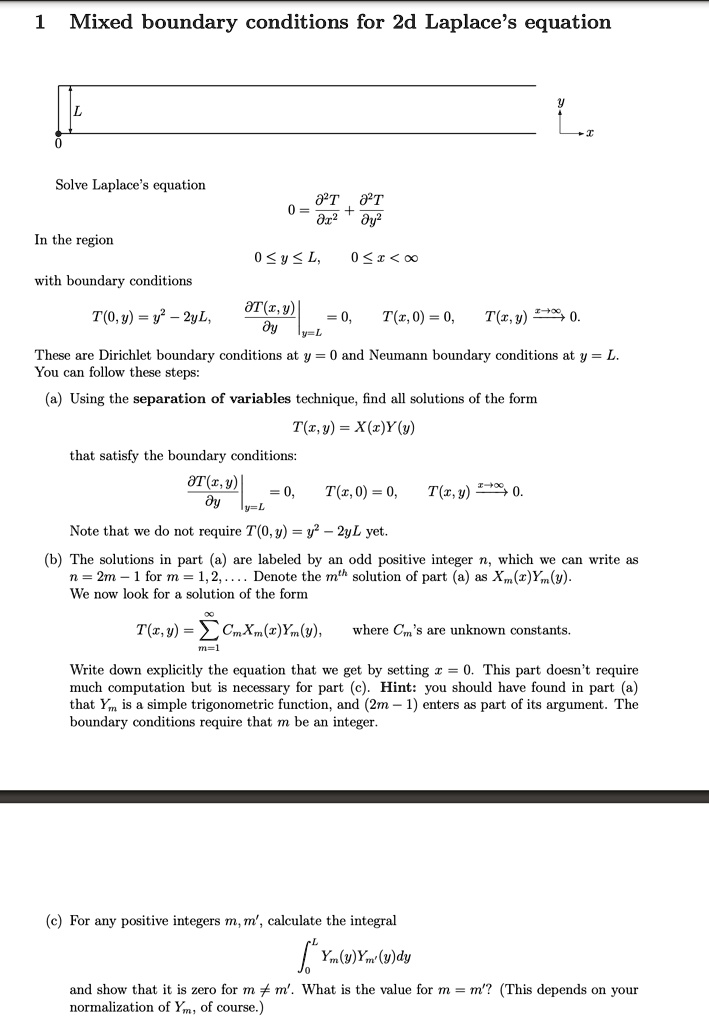
L
0
Solve Laplace's equation
$\frac{\partial^2 T}{\partial x^2} + \frac{\partial^2 T}{\partial y^2} = 0$
In the region
$0 \le y \le L$,
$0 \le x < \infty$
with boundary conditions
$T(0, y) = y^2 - 2yL$,
$\frac{\partial T(x, y)}{\partial y}|_{y=L} = 0$,
$T(x, 0) = 0$,
$\lim_{x \to \infty} T(x, y) \to 0$.
These are Dirichlet boundary conditions at y = 0 and Neumann boundary conditions at y = L.
You can follow these steps:
(a) Using the separation of variables technique, find all solutions of the form
$T(x, y) = X(x)Y(y)$
that satisfy the boundary conditions:
$\frac{\partial T(x, y)}{\partial y}|_{y=L} = 0$,
$T(x, 0) = 0$,
$\lim_{x \to \infty} T(x, y) \to 0$.
Note that we do not require $T(0, y) = y^2 - 2yL$ yet.
(b) The solutions in part (a) are labeled by an odd positive integer n, which we can write as
$n = 2m - 1$ for $m = 1, 2, \dots$. Denote the $m^{th}$ solution of part (a) as $X_m(x)Y_m(y)$.
We now look for a solution of the form
$T(x, y) = \sum_{m=1}^{\infty} C_m X_m(x)Y_m(y)$, where $C_m$'s are unknown constants.
Write down explicitly the equation that we get by setting x = 0. This part doesn't require
much computation but is necessary for part (c). Hint: you should have found in part (a)
that $Y_m$ is a simple trigonometric function, and $(2m - 1)$ enters as part of its argument. The
boundary conditions require that m be an integer.
(c) For any positive integers m, m', calculate the integral
$\int_0^L Y_m(y)Y_{m'}(y)dy$
and show that it is zero for $m \ne m'$. What is the value for $m = m'$? (This depends on your
normalization of $Y_m$, of course.)