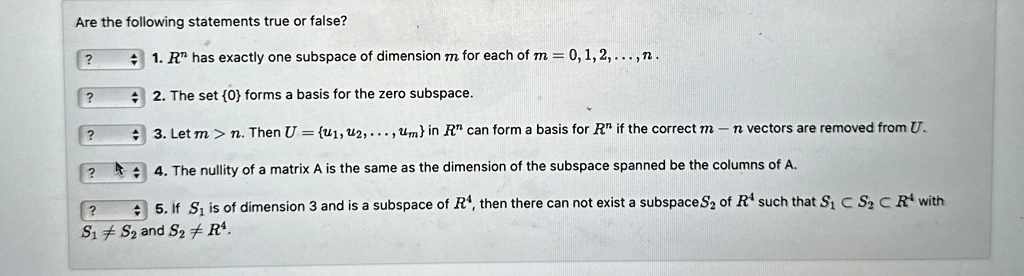
1. $\mathbb{R}^n$ has exactly one subspace of dimension $m$ for each of $m = 0, 1, 2, \dots, n$.
2. The set $\{0\}$ forms a basis for the zero subspace.
3. Let $m > n$. Then $U = \{u_1, u_2, \dots, u_m\}$ in $\mathbb{R}^n$ can form a basis for $\mathbb{R}^n$ if the correct $m - n$ vectors are removed from $U$.
4. The nullity of a matrix $A$ is the same as the dimension of the subspace spanned by the columns of $A$.
5. If $S_1$ is of dimension 3 and is a subspace of $\mathbb{R}^4$, then there can not exist a subspace $S_2$ of $\mathbb{R}^4$ such that $S_1 \subset S_2 \subset \mathbb{R}^4$ with $S_1 \neq S_2$ and $S_2 \neq \mathbb{R}^4$.