2. Time Development of Free Particle Superposition of Momentum Eigenstates
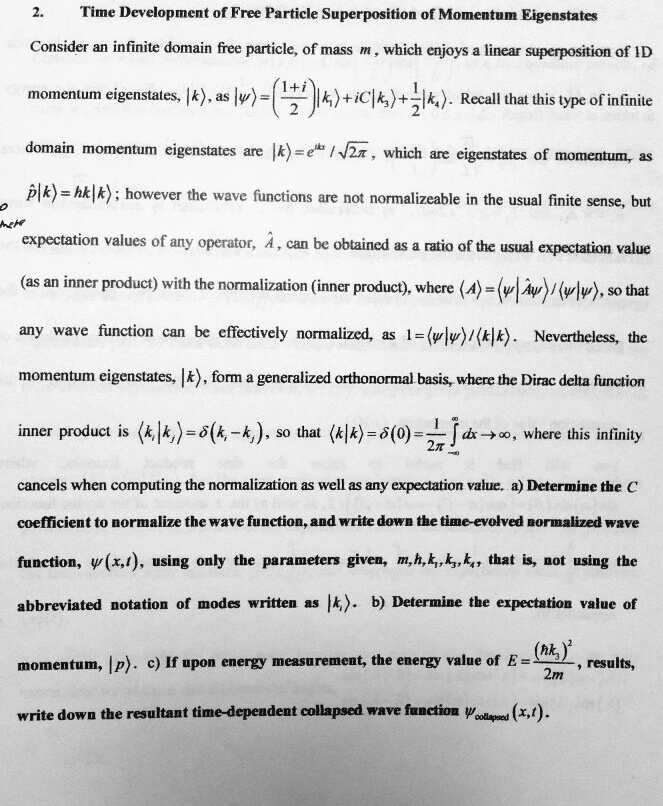
Consider an infinite domain free particle, of mass $m$, which enjoys a linear superposition of 1D
momentum eigenstates, $|k\rangle$, as $|\psi\rangle = \frac{1+i}{2}|k_1\rangle + iC|k_2\rangle + \frac{1-i}{2}|k_3\rangle$. Recall that this type of infinite
domain momentum eigenstates are $\langle x|k\rangle = e^{ikx}/\sqrt{2\pi}$, which are eigenstates of momentum, as
$\hat{p}|k\rangle = \hbar k|k\rangle$; however the wave functions are not normalizable in the usual finite sense, but
expectation values of any operator, $\hat{A}$, can be obtained as a ratio of the usual expectation value
(as an inner product) with the normalization (inner product), where $\langle A\rangle = \frac{\langle\psi|\hat{A}|\psi\rangle}{\langle\psi|\psi\rangle}$, so that
any wave function can be effectively normalized, as $1 = \frac{\langle\psi|\psi\rangle}{\langle k|k\rangle}$. Nevertheless, the
momentum eigenstates, $|k\rangle$, form a generalized orthonormal basis, where the Dirac delta function
inner product is $\langle k|k'\rangle = \delta(k-k')$, so that $\langle k|k\rangle = \delta(0) = \frac{1}{2\pi}\int^{\infty}_{-\infty} dx \to \infty$, where this infinity
cancels when computing the normalization as well as any expectation value. a) Determine the $C$
coefficient to normalize the wave function, and write down the time-evolved normalized wave
function, $\psi(x,t)$, using only the parameters given, $m,\hbar,k_1,k_2,k_3$, that is, not using the
abbreviated notation of modes written as $|k\rangle$. b) Determine the expectation value of
momentum, $\langle p\rangle$. c) If upon energy measurement, the energy value of $E = \frac{(\hbar k)^2}{2m}$ results,
write down the resultant time-dependent collapsed wave function $\psi_{collapsed}(x,t)$.