Ace - AI Tutor
Ask Our Educators
Textbooks
My Library
Flashcards
Scribe - AI Notes
Notes & Exams
Download App
john williams

john w.

Divider

Questions asked

BEST MATCH

5. [10 Pts] Compressed liquid water at 20 °C and 500 kPa is entering a heat exchanger at a rate of 5 kg/s. The water exchanges heat with a stream of R-134a that goes from superheated at 50 °C and 500 kPa to a binary mixture at 15 °C with a quality 20%. The exiting water is at 25 °C. According to the density difference, steam and liquid water are separated through two different exiting channels as shown below. If the exiting steam mass flux rate is 3.5 kg/s, what is the mass flux rate of R-134a? 20% quality R-134a @15 °C Water in (5 kg/s) Steam out (3.5 kg/s) Water out Superheated R-134a (50 °C, 500 kPa)

View Answer
divider
BEST MATCH

The oxidation number of P in PO4 3- is: Group of answer choices -3 +8 -5 +5 none of the above

View Answer
divider
BEST MATCH

describe the difference between the regression equation W2D1 and the regression equation W2D2.

View Answer
divider
BEST MATCH

Q1. Using the architecture of a house or building as a metaphor, draw comparisons with software architecture. How are the disciplines of classical architecture and the software architecture similar? How do they differ? Q2. Transform mapping is a set of design steps that allows a DFD with transform flow characteristics to be mapped into a specific architectural style. Illustrate the steps of Architectural Mapping of "SafeHome security function".

View Answer
divider
BEST MATCH

The pendulum is raised to an angle of π/12 radians and released from rest. Write down all the relevant displacement, velocity, and acceleration conditions - known, unknown, or calculated - for the rotational motion of the pendulum. Using θ(t) = θ₀ * cos(√(g/L)t), find ω(t) and a(t). Hint: y = cos(kx) => dy/dx = -k * sin(kx)

View Answer
divider
BEST MATCH

One month ago, a teenage girl stopped eating animal-derived foods and now only consumes vegetables and fruits. She is now experiencing a cold and/or an infection. This is probably due to inadequate protein intake.

View Answer
divider
BEST MATCH

Which of the following variables are endogenous in the supply and demand model? (Hint: \"Exogenous\" variables are those whose value is determined within their models while \"exogenous\" variables are set outside the models.) Check all that apply. Price of a snow shovel Equilibrium quantity of snow shovels Chance of snow Which of the following formulas correctly states the demand for snow shovels in functional form? $P = D(Q^D, C)$

View Answer
divider
BEST MATCH

Describe in detail a story of a person you know who has obsessive-compulsive disorder. How will help this person

View Answer
divider
BEST MATCH

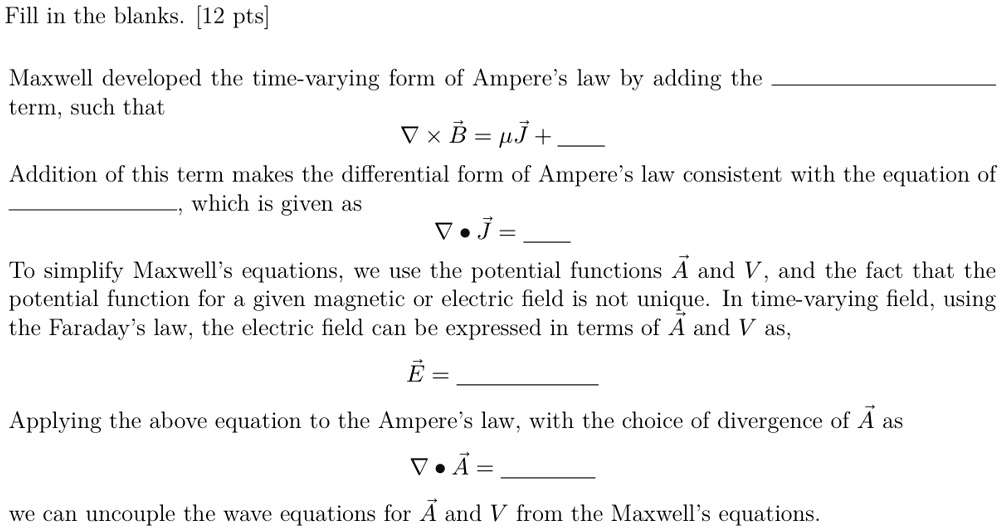
Fill in the blanks. [12 pts] Maxwell developed the time-varying form of Ampere's law by adding the ____ term, such that $\nabla \times \vec{B} = \mu \vec{J} +$ ____ Addition of this term makes the differential form of Ampere's law consistent with the equation of ____, which is given as $\nabla \cdot \vec{J} =$ ____ To simplify Maxwell's equations, we use the potential functions $\vec{A}$ and $V$, and the fact that the potential function for a given magnetic or electric field is not unique. In time-varying field, using the Faraday's law, the electric field can be expressed in terms of $\vec{A}$ and $V$ as, $\vec{E} =$ ____ Applying the above equation to the Ampere's law, with the choice of divergence of $\vec{A}$ as $\nabla \cdot \vec{A} =$ ____ we can uncouple the wave equations for $\vec{A}$ and $V$ from the Maxwell's equations.
View Answer
divider
BEST MATCH

Texts: P4.18 Consider the case where a random process {x(n)} is generated as in Figure P4.18 I[(6-u)x ... (I-u)x (u)x]=(u)x (i) Find and present the correlation matrix R = E[x(n)x(n)]. (ii) Find and present the eigenvalues, λ, and eigenvectors, qᵢ, of R. (iii) Present a plot of the power spectral density X(eᵢ). (iv) Add the plots of the magnitude responses of the eigenfilters of R to the power spectral density plot in Part (iii). (v) Make an attempt to relate the plots in Part (iv) to the eigenvalues in Part (ii). Unit variance H(z) = 1 + 2z⁻¹ - z⁻² white process Figure P4.18 Unit variance white process H Figure P4.20

View Answer
divider