Ace - AI Tutor
Ask Our Educators
Textbooks
My Library
Flashcards
Scribe - AI Notes
Notes & Exams
Download App
jonathan moore

jonathan m.

Divider

Questions asked

BEST MATCH

in a collagen triple helix, what is located in the helix interior

View Answer
divider
BEST MATCH

A client who received intravenous magnesium sulfate for preeclampsia gives birth. What clinical finding in the newborn indicates to the nurse that magnesium sulfate toxicity may have occurred?

View Answer
divider
BEST MATCH

Consider a 15-year bond that has a 5.5 percent coupon, paid semi-annually. If the current market interest rates is 6.5 percent, what is the price? Please write down the inputs, such as N, PV, PMT, etc

View Answer
divider
BEST MATCH

MC Hw\# 12 Verity the row in \( \left[T_{3}\right] \) and \( \left[T_{3}^{*}\right] \) witing the tensitr strees and strain dranstormations \[ \begin{array}{l} v_{k l}^{\prime}=\sigma_{i j} l_{k i} l_{\ell j} \\ \varepsilon_{k l}^{\prime}=\varepsilon_{i j} \ell_{k i} l_{j} \end{array} \] notice \( \gamma_{i j}=2 \varepsilon_{i j} \) for the \( t_{3}^{*} \) madoux

View Answer
divider
BEST MATCH

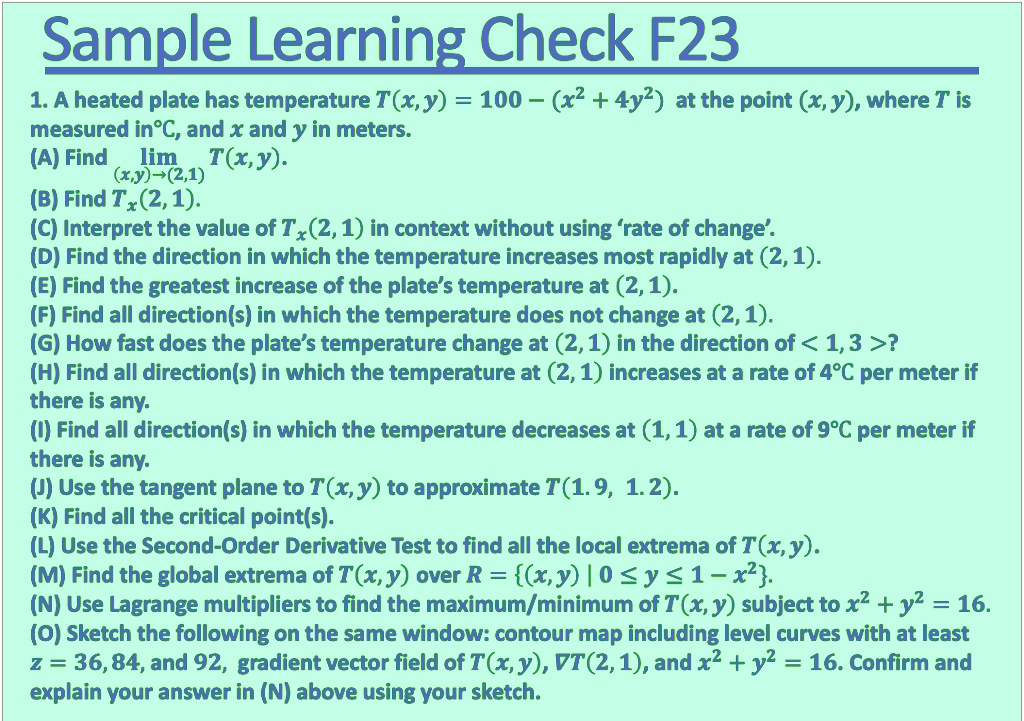
1. A heated plate has temperature $T(x, y) = 100 - (x^2 + 4y^2)$ at the point (x, y), where T is measured in °C, and x and y in meters. (A) Find $\lim_{(x,y) \to (2,1)} T(x, y)$. (B) Find $T_x(2, 1)$. (C) Interpret the value of $T_x(2, 1)$ in context without using 'rate of change'. (D) Find the direction in which the temperature increases most rapidly at (2, 1). (E) Find the greatest increase of the plate's temperature at (2, 1). (F) Find all direction(s) in which the temperature does not change at (2, 1). (G) How fast does the plate's temperature change at (2, 1) in the direction of $<1, 3>$? (H) Find all direction(s) in which the temperature at (2, 1) increases at a rate of 4°C per meter if there is any. (I) Find all direction(s) in which the temperature decreases at (1, 1) at a rate of 9°C per meter if there is any. (J) Use the tangent plane to T(x, y) to approximate T(1.9, 1.2). (K) Find all the critical point(s). (L) Use the Second-Order Derivative Test to find all the local extrema of T(x, y). (M) Find the global extrema of T(x, y) over R = {(x, y) | 0 ≤ y ≤ 1 - x²}. (N) Use Lagrange multipliers to find the maximum/minimum of T(x, y) subject to x² + y² = 16. (O) Sketch the following on the same window: contour map including level curves with at least z = 36, 84, and 92, gradient vector field of T(x, y), VT(2, 1), and x² + y² = 16. Confirm and explain your answer in (N) above using your sketch.
View Answer
divider
BEST MATCH

Question 4 1 pts When lifespan development researchers use _______, they draw on several perspectives simultaneously because they recognize that the same developmental phenomenon can be viewed from a number of angles. a macrosystems approach an eclectic approach an evolutionary approach an ecological approach

View Answer
divider
BEST MATCH

Which defense mechanism involves returning to an earlier, less mature stage of development? a. Regression b. Reaction formation c. Rationalization d. Sublimation

View Answer
divider
BEST MATCH

Let $f = \frac{x^2 - 4x - 32}{x^2 - x - 20}$. At which point $f$ has a continuous extension?

View Answer
divider
BEST MATCH

In a typical tension test, a dog-bone-shaped specimen is pulled in a machine. During the test, the force F needed to pull the specimen and the length L of a gauge section are measured. This data is used for plotting a stress-strain diagram of the material. Two definitions, engineering and true, exist for stress and strain. The engineering stress σe and strain εe are defined by: σe = F / Ao εe = (L - Lo) / Lo where Lo and Ao are the initial gauge length and the initial cross-section area of the specimen, respectively. The true stress σt and strain εt are defined by: σt = F / Ao εt = ln(L / Lo) The following are the measurements of force and gauge length from a tension test with an aluminum specimen. The specimen has a round cross-section with a radius of 6.4mm (before the test). The initial gauge length is Lo = 25mm. a. Use the data to calculate and print the engineering and the true stress-strain curves. b. Plot the engineering and true stress-strain curves, both on the same plot of the material. Label the axes and label the curves. Units: When the force is measured in Newtons (N), and the area is calculated in m², the units of stress are Pascals (Pa). F (N) 0 13345 26689 40479 42703 43592 44482 44927 45372 L (mm) 25 25.037 25.073 25.113 25.122 25.125 25.132 25.144 25.164 F (N) 46276 47908 26689 49035 50265 53213 44482 56.161 L (mm) 25.208 25.409 25.073 25.646 26.084 25.125 27.398 29.150 Requirements: Use a vector of structures to store the force F and the gauge length L from the table. Use two functions, E_stress_strain and T_stress_strain, to calculate the engineering and the true stress-strain, respectively. Please write code in C++ and follow all instructions.

View Answer
divider
BEST MATCH

Part II: Estimating Heat of Reaction from ?H<sup>o</sup> Find the value of ?H<sup>o</sup> for the reaction H<sub>2</sub>O<sub>2</sub> (l) ? H<sub>2</sub>O (l) + 1/2 O<sub>2</sub> (g) from these values of ?H<sup>o</sup><sub>f</sub>: H<sub>2</sub>O (l) = -286 kJ/mol H<sub>2</sub>O<sub>2</sub> = -188 kJ/mol (show calculation) ?H<sup>o</sup> _______ kJ/mol

View Answer
divider