Ace - AI Tutor
Ask Our Educators
Textbooks
My Library
Flashcards
Scribe - AI Notes
Notes & Exams
Download App
jose antonio barker

jose antonio b.

Divider

Questions asked

BEST MATCH

The brain and spinal cord are surrounded by three protective membranes collectively known as: Question 17 options: 1) The meninges 2) The myelin 3) The cerebral cortex 4) The cerebral ventricles

View Answer
divider
BEST MATCH

Which of these Big Five (OCEAN) personality traits typically decreases throughout middle adulthood? Group of answer choices Neuroticism Conscientiousness Extraversion Openness to Experience

View Answer
divider
BEST MATCH

Efficiency wages cause ____ unemployment, unions cause ____ unemployment. frictional; frictional structural; frictional frictional; structural structural; structural

View Answer
divider
BEST MATCH

A $73,030 loan is taken out on a boat with the terms 5% APR for 31 months. How much are the monthly payments on this loan?

View Answer
divider
BEST MATCH

Find angle x. 10.87deg 18.13deg 38.66deg 15.34deg Find angle x 5 4 10.87o 18.13 38.66 15.34

View Answer
divider
BEST MATCH

Consider the following picture of a graphical method of solving an L.P. Answer the questions below C= (2,7) improves Feasible Region Objective function: Min $4x_1 + 5x_2$ B= (5,2) A= (3,1) (5 points) a. What is the value of objective function at Point A (3,1) (5 points) b. What is the optimal solution? (5 points) c. Is Point B(5,2) a feasible solution? (5 points) d. What is the value of objective function at Point B(5,2)? (5 points) e. Is C(2,7) a feasible solution? Blue is the feasible region. Objective function line is shown along with direction of improvement.

View Answer
divider
BEST MATCH

Problem #7: Let C be the closed oriented curve in the x, y-plane consisting of the line segment from (0,0) to (3,0), the line [5 marks] segment from (3, 0) to (3,81) and the part of the curve $y = x^4$ starting at (3, 81) and ending back at (0,0). Compute the line integral $I = \int_C (e^{x^2} - y) dx + (cos(e^y) + x) dy$. Hint: Use Green's Theorem. (A) $\frac{81}{7}$ (B) $\frac{1458}{5}$ (C) $\frac{729}{4}$ (D) $\frac{486}{5}$ (E) $\frac{81}{5}$

View Answer
divider
BEST MATCH

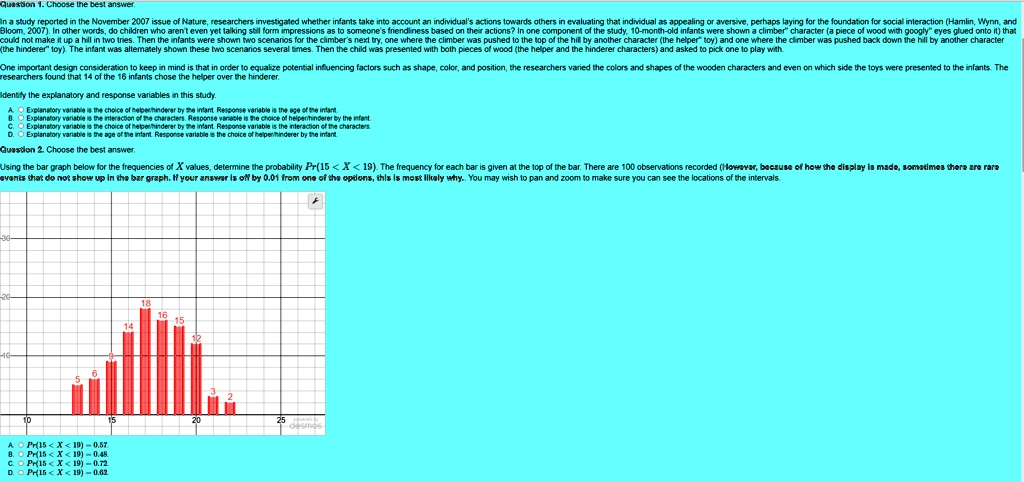
In a study reported in the November 2007 issue of Nature, researchers investigated whether infants take into account an individual's actions towards others in evaluating that individual as appealing or aversive, perhaps laying the foundation for social interaction (Hamlin, Wynn, and Bloom, 2007). In other words, do children who aren't even yet talking still form impressions as to someone's friendliness based on their actions? In one component of the study, 10-month-old infants were shown a climber character (a piece of wood with googly eyes glued onto it) that could not make it up a hill in two tries. Then the infants were shown two scenarios for the climber's next try, one where the climber was pushed to the top of the hill by another character (the helper toy) and one where the climber was pushed back down the hill by another character (the hinderer toy). The infant was alternately shown these two scenarios several times. Then the child was presented with both pieces of wood (the helper and the hinderer characters) and asked to pick one to play with. One important design consideration to keep in mind is that in order to equalize potential influencing factors such as shape, color, and position, the researchers varied the colors and shapes of the wooden characters and even on which side the toys were presented to the infants. The researchers found that 14 of the 16 infants chose the helper over the hinderer. Identify the explanatory and response variables in this study. The explanatory variable is the choice of helper/hinderer by the infant. The response variable is the interaction of the characters. Question 2. Choose the best answer. Using the bar graph below for the frequencies of X values, determine the probability Pr(15 < X < 19). The frequency for each bar is given at the top of the bar. There are 100 observations recorded. However, because of how the data is displayed, sometimes there are bars that do not show up in the bar graph. If your answer is off by 0.01 from one of the options, this is most likely why. You may wish to pan and zoom to make sure you can see the locations of the intervals. Pr(15 < X < 19) = 0.57. Pr(15 < X < 19) = 0.48. Pr(15 < X < 19) > 0.72. Pr(15 < X < 19) < 0.63.
View Answer
divider
BEST MATCH

3. For the CE amplifier shown below, $R_{sig} = 10 \text{ k}\Omega$, $R_{B1} = 68 \text{ k}\Omega$, $R_{B2} = 27 \text{ k}\Omega$, $R_E = 2.2 \text{ k}\Omega$, $R_C = 4.7 \text{ k}\Omega$, and $R_L = 10 \text{ k}\Omega$. Assume $I_C = 0.8 \text{ mA}$, $\beta = 200$, unity gain $f_T = 1 \text{ GHz}$, and $C_\mu = 0.8 \text{ pF}$. (a) Neglecting $r_x$ and $r_o$, find the midband gain $A_M$ and the upper 3dB cutoff frequency $f_H$.

View Answer
divider
BEST MATCH

Suppose a project costs $50,000 today and it is projected to generate a single inflow of $65,000 in two years. What is this project's IRR? Answer in percent, rounded to two decimal places.

View Answer
divider