Questions asked
Explain what is meant by “a muscle pulls the bone to which it is attached- it can move the bone only in one direction.
Alzheimer's disease primarily affects: Question 7Answer a. The kidneys b. The liver c. The heart d. The brain
The nephron loop's ascending limb \_\_\_\_\_\_\_\_. acts to excretes K ions actively reabsorbs NaCl helps to pack a greater number of nephron loops into a smaller space aids in the passive movement of water out of the tubule
Some diuretics can lead to a deficiency of what nutrient? A Sodium B Calcium C Potassium D Phosphate E Manganese
Canned foods are sterile because lack of oxygen prevents the growth of contaminating bacteria. True False
The text provided does not contain any spelling, typographical, grammatical, OCR, or mathematical errors.
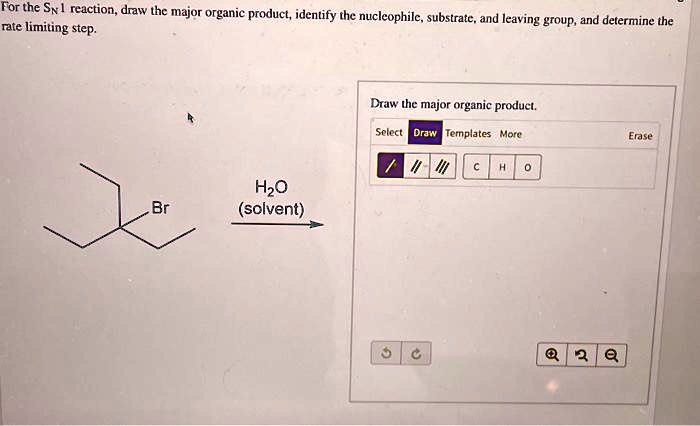
For the Sn1 reaction, draw the major organic product, identify the nucleophile, substrate, and leaving group, and determine the rate limiting step. Br H2O (solvent) Draw the major organic product. Select Draw Templates More Erase ///// C H O ???
Your credit card has a balance of $5200 and an annual interest rate of 18%. You decide to pay off the balance over three years. If there are no further purchases charged to the card, you must pay $187.99 each month, and you will pay a total interest of $1567.64. Assume you decide to pay off the balance over one year rather than three. How much more must you pay each month and how much less will you pay in total interest?\Use PMT = \frac{P\left(\frac{r}{n}\right)}{1-\left(1+\frac{r}{n}\right)^{-nt}} to determine the regular payment amount.\You will pay $ more each month.\(Round to the nearest cent as needed.)\You will pay $ less in total interest.\(Round to the nearest cent as needed.)
The yield to maturity of a $1,000 bond with a 6.5% coupon rate, semiannual coupons, and two years to maturity is 7.9% APR, compounded semiannually. What is its price? The price of the bond is $_____. (Round to the nearest cent.)
Question 59 What value will be printed after the following lines of code are executed? x = 15 def f(): x = 100 return x f() print(x) 1 pts