KNS2723 Numerical Methods and Statistics
Assignment: Discrete Uniform Distribution
Question 1
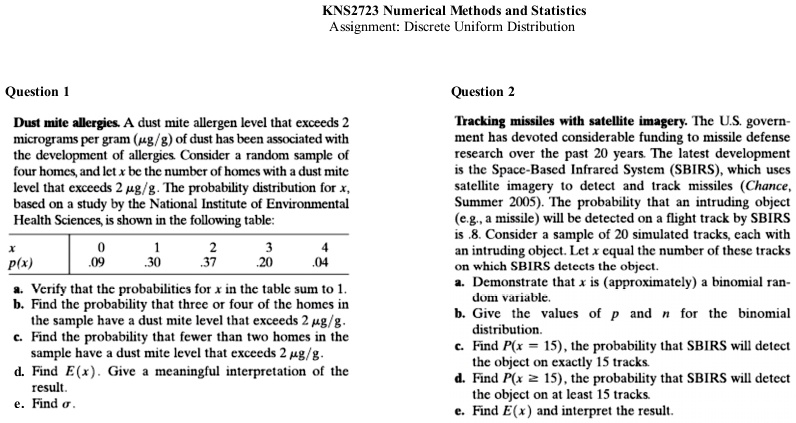
Dust mite allergies. A dust mite allergen level that exceeds 2
micrograms per gram (µg/g) of dust has been associated with
the development of allergies. Consider a random sample of
four homes, and let x be the number of homes with a dust mite
level that exceeds 2 µg/g. The probability distribution for x,
based on a study by the National Institute of Environmental
Health Sciences, is shown in the following table:
X
p(x)
0
.09
1
.30
2
.37
3
.20
4
.04
a. Verify that the probabilities for x in the table sum to 1.
b. Find the probability that three or four of the homes in
the sample have a dust mite level that exceeds 2 µg/g.
c. Find the probability that fewer than two homes in the
sample have a dust mite level that exceeds 2 µg/g.
d. Find E(x). Give a meaningful interpretation of the
result.
e. Find σ.
Question 2
Tracking missiles with satellite imagery. The U.S. govern-
ment has devoted considerable funding to missile defense
research over the past 20 years. The latest development
is the Space-Based Infrared System (SBIRS), which uses
satellite imagery to detect and track missiles (Chance,
Summer 2005). The probability that an intruding object
(e.g., a missile) will be detected on a flight track by SBIRS
is .8. Consider a sample of 20 simulated tracks, each with
an intruding object. Let x equal the number of these tracks
on which SBIRS detects the object.
a. Demonstrate that x is (approximately) a binomial ran-
dom variable.
b. Give the values of pand n for the binomial
distribution.
c. Find P(x = 15), the probability that SBIRS will detect
the object on exactly 15 tracks.
d. Find P(x≥ 15), the probability that SBIRS will detect
the object on at least 15 tracks.
e. Find E(x) and interpret the result.