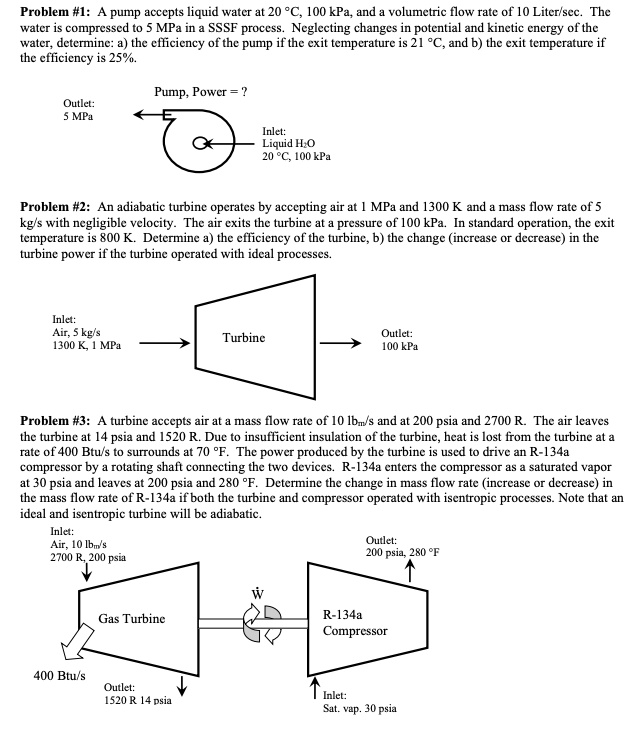
Problem #1: A pump accepts liquid water at 20 C, 100 kPa, and a volumetric flow rate of 10 Liter/sec. The water is compressed to 5 MPa in a SSSF process. Neglecting changes in potential and kinetic energy of the water, determine: a) the efficiency of the pump if the exit temperature is 21 C, and b) the exit temperature if the efficiency is 25%.
Pump, Power = ?
Outlet: 5 MPa
Inlet: Liquid HO 20 C, 100 kPa
Problem #2: An adiabatic turbine operates by accepting air at 1 MPa and 1300 K and a mass flow rate of 5 kg/s with negligible velocity. The air exits the turbine at a pressure of 100 kPa. In standard operation, the exit temperature is 800 K. Determine a) the efficiency of the turbine, b) the change (increase or decrease) in the turbine power if the turbine operated with ideal processes.
Inlet: Air, 5 kg/s 1300 K, 1 MPa
Turbine
Outlet: 100 kPa
Problem #3: A turbine accepts air at a mass flow rate of 10 lbm/s and at 200 psia and 2700 R. The air leaves the turbine at 14 psia and 1520 R. Due to insufficient insulation of the turbine, heat is lost from the turbine at a rate of 400 Btu/s to surrounds at 70 F. The power produced by the turbine is used to drive an R-134a compressor by a rotating shaft connecting the two devices.R-134a enters the compressor as a saturated vapor at 30 psia and leaves at 200 psia and 280 F. Determine the change in mass flow rate (increase or decrease) in the mass flow rate of R-134a if both the turbine and compressor operated with isentropic processes. Note that an ideal and isentropic turbine will be adiabatic. Inlet: Air, 10 lbm/s Outlet: 2700 R, 200 psia 200 psia, 280 F
W
Gas Turbine
R-134a Compressor
400 Btu/s Outlet: 1520 R 14 psia
Inlet: Sat. vap. 30 psia